
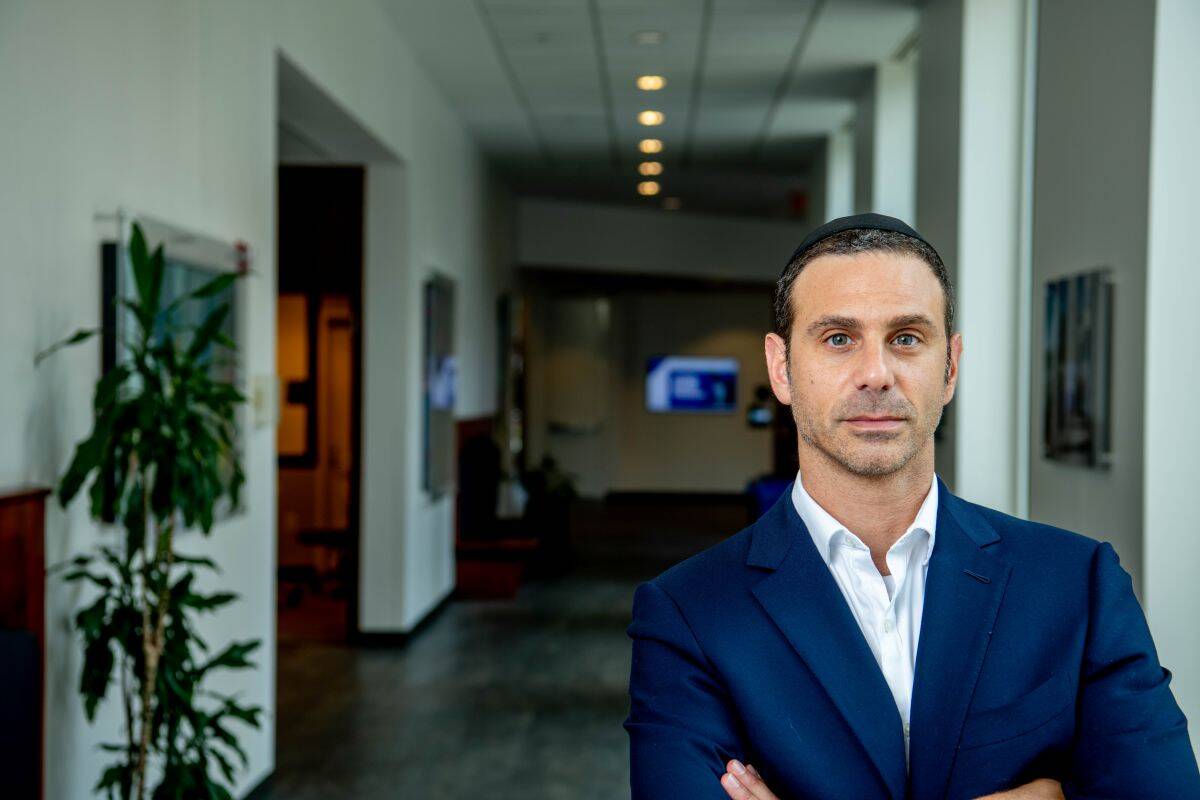
Associate Professor in the Practice of Organization & Management Ira Bedzow explains how there is always a choice, if you’re willing to practice this simple reframe that open doors where you only saw walls
Last year, a senior leader told her team, “Layoffs had to happen.” The room went quiet. The decision was framed as inevitable, as if market forces reached into the office and made the call themselves. But markets do not speak—people do. And what she meant was this: we chose layoffs over other options. The language she used was not cosmetic. It was a choice.
It’s a common assumption that people are constrained by their environment. We see this in psychology when we talk about how priming influences behavior, how habits automate decision-making, how emotional conditioning shapes perception, and how cognitive biases narrow interpretation. The idea is also reinforced in the neuroscience literature that describes how so much of our processing is fast, predictive, and automatic.

Most importantly, we see it in how we talk. We often speak in passive voice. Have you ever said or heard the following?
“Mistakes were made.”
“It got handled poorly.”
“The project failed.”
In each of these sentences, the actor is both hidden and external. What is lost is us as agents in our own lives.
Even when we don’t speak in the passive voice, we describe our situations in ways that take away our agency. Think of the following examples:
“That comment made me angry.”
“The culture here forces people to behave this way.”
“Given my upbringing, this is just who or how I am.”
Speaking in passive voice reflects what psychologists call external locus of control, which is the belief that outcomes are driven primarily by forces outside oneself. In the language of behavioral economists, it speaks to diffusion of responsibility.
But even if it is true that outside factors always exist, we oftentimes find ourselves sliding from influence to inevitability. We treat context as a cause rather than a condition. We go too far in thinking that these factors cause us to act rather than inform us how we can best act. However, between stimulus and response, there is cognitive space, and even if small, utilizing it changes everything.
So, instead of framing events in passive voice or through an external locus of control, we can live in active voice and recognize that everything is a choice. Active voice strengthens what philosophers call moral accountability and what psychologists call metacognition, i.e., thinking about your own thinking. For the philosopher, active voice brings light to the fact that the subject is the cause of an action. For the psychologist, active voice allows the speaker to question whether the subject must necessarily cause that action or whether they can act a different way.
Active voice doesn’t just describe agency. It activates it by providing a frame to imagine efficacy, no matter how small the change is, and when you can imagine that you can do something, your motivation to do something grows.
Everything is a Choice
When you say, “Everything is a choice,” you do not deny constraints. You refuse to let constraints masquerade as inevitabilities. So, instead, you can say:
I heard that comment, and I chose to become angry, but I can choose differently.”
“I can choose to act on my own values, even if doing so is outside the norm.”
“I was brought up a given way, but I can choose to act differently.”

When you do this, you don’t ignore the potential consequences of acting how you choose to—you prepare either to mitigate the consequences or change the dynamic. For example, the Pygmalion Effect explains that higher expectations lead to improved performance. So, when you choose to interpret someone’s actions positively rather than negatively, and respond in a way that communicates your assumption, the person may very well live up to your expectation.
We also begin to realize that staying silent, complying with demands that go against our values, or conforming to a toxic culture is also a choice we make. We can no longer hide behind a sense of inevitability.
Choosing—rather than reacting—allows us to ask ourselves:
What am I afraid of?
What am I protecting?
What tradeoff am I making?
What value am I subordinating?
Importantly, the empowerment that comes with making choices can even allow you to ask, “What option am I pretending doesn’t exist?” You can thereby become more imaginative in creating options that you wouldn’t see otherwise.
What is Rationalization—and What is Reason?
In my work, the difference between using passive versus active voice—or accepting an external versus internal locus of control—speaks to the difference between giving rationalizations versus giving reasons for leadership decisions.
Rationalizations are what happen when we let constraints do our thinking for us. They sound like reasons, but they function differently. A rationalization is a justification not to make a change. For example, when we rationalize inaction, we say:
“That’s just how this industry works.”
“It’s not my responsibility.”
“I don’t have enough power.”
Each of these statements points to something real. Industries have norms. Roles have limits. Power is unevenly distributed. But notice what happens in the framing: The constraint becomes the cause. The influence becomes fate. The conversation ends.
A reason, on the other hand, provides an explanation for why you want to make a change. The former names a constraint to close the conversation; the latter acknowledges the constraint as an obstacle but not as a barricade. With reasons, we maintain agency and give ourselves a chance to do things differently. A reason says, this is difficult, and here is why it is still worth attempting.
When we set ourselves up to make a choice, we don’t start with the question, “Can I do something?” we start with “How can I do something?” This enabling stance allows you to recognize two things. First, even if you can’t do everything, you do have the ability to do something. Second, options are no longer framed as “either-or” but rather consist as a variety of pathways, each of which is more or less suitable to the abilities you have and the constraints that you face.
Let’s try on that reframe and see how it feels.
“That’s just how this industry works.”
If the industry works a certain way, you still can work differently with people.
“It’s not my responsibility.”
Even if something is not your responsibility, that doesn’t mean people won’t be persuaded by you.
“I don’t have enough power.”
Even if you don’t have enough power alone, there may be allies and supporters willing to lend a hand.
Once you see the difference between reasons and rationalizations, you can also anticipate them and prepare counterarguments before you hear others say them.
Here’s where this becomes an essential lesson in leadership. When leaders demonstrate how everything is a choice, they not only empower themselves to act differently, they empower their teams and organizations through modelling.
Actions of leaders shape the expectations and possibilities for organizations because they communicate much more loudly than any finely crafted pronouncement. Action—and inaction—defines not only the purpose of an organization but also how the organization will pursue its purpose.

So, instead of saying, “Layoffs had to happen,” when leaders say, “We chose layoffs over the following options…” they can expose the tradeoffs and can speak to why the choice demonstrates values prioritization. They can also show how they considered the consequences for those laid off and for those who remain.
“Everything is a choice” is not naïve optimism. It is a moral claim that says that you are not merely the result of external forces but rather a participant in shaping who you are and can become.
Language shapes perception—choose active voice.
Perception shapes the options available to act on—choose to interpret events accurately and productively.
Actions shape character—choose to respond rather than react.
When you do this, both you and your teams or organizations will be better for it.
Goizueta faculty apply their expertise and knowledge to solving problems that society—and the world—face. Learn more about faculty research at Goizueta.