
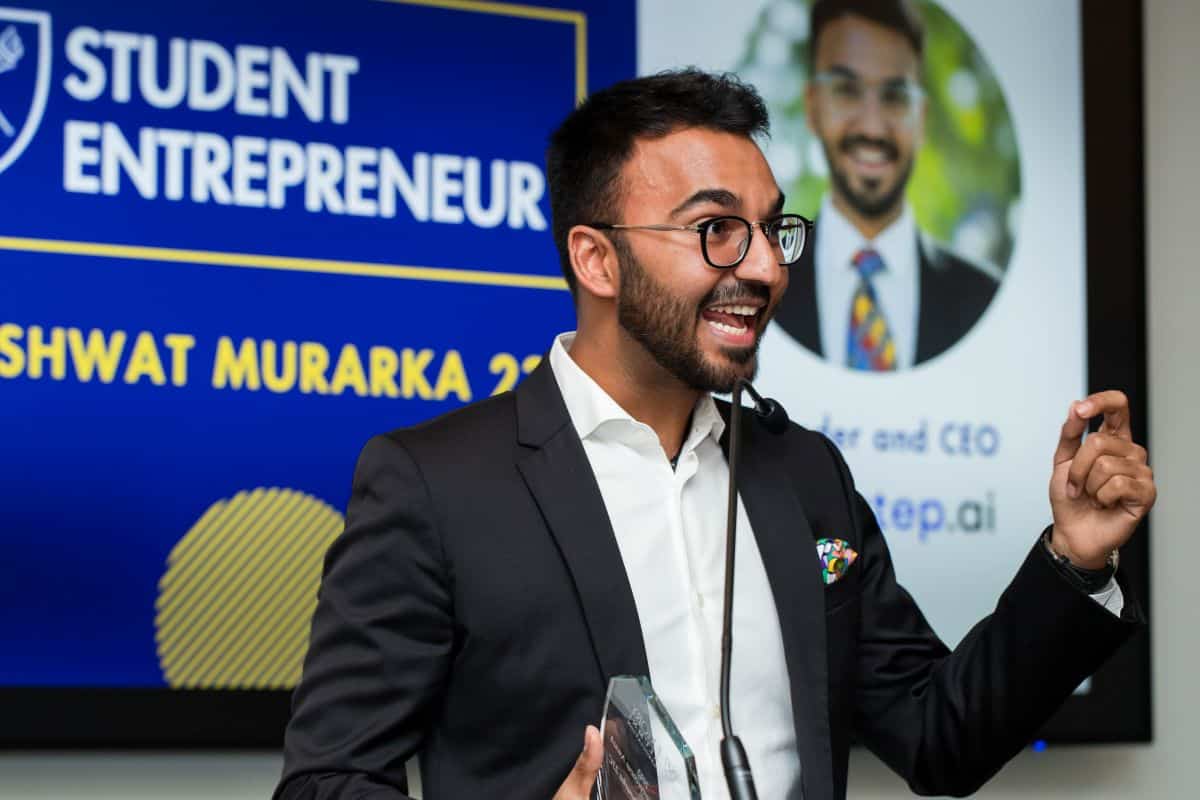
The story of Doorstep.ai starts with Shashwat Murarka’s empty stomach.
Murarka was completing an internship the summer after his junior year in New York City and—like many students, and city-dwellers in general—he didn’t have access to a car. What he did have was a frequent yen for Indian and Thai food, and a front door that was evidently hard to find. He ordered a lot of takeout, and frequently found himself on the phone, trying to coach delivery drivers on how to find him.
He thought it was an issue unique to New York City, but the same phenomenon occurred when he visited Chicago, and then again when he moved back to Decatur, Georgia for his senior year. The problem was persistent across delivery platforms; the most potent variable in determining whether his Pad Thai arrived in a timely manner was the driver themselves, and their commitment to playing a game of “warmer/colder” with him.
“After the 200th driver asking me how to find the front door, I became obsessed with this problem,” says Murarka.
The Last 500 Feet
Why does GPS fall short in these scenarios?
“GPS signals are significantly affected by the elevation angles of satellites,” Murarka explains. “Outside a building it’s fairly accurate. If you live in an ‘urban canyon,’ which is common in cities, or if you’re navigating around densely populated areas like office building parks or even hospitals, the GPS is consistently way off. And when you go inside a building, it’s a blind spot.”
GPS also cannot make heads or tails of elevation, which is an issue for the many people who don’t live in single family homes.
Although he didn’t realize it yet, Murarka was beginning to scratch the surface of an even bigger issue: when people, packages, or emergency responders can’t quickly find the right door, the consequences can range from inconvenient to life-threatening.
A Reconnaissance Mission for Research
To get to the bottom of this problem, Murarka had to explore the end user side of things—he needed to experience the situation as a delivery driver.
“I’ve been thrown out of many apartment complexes,” he confesses, and laughs.
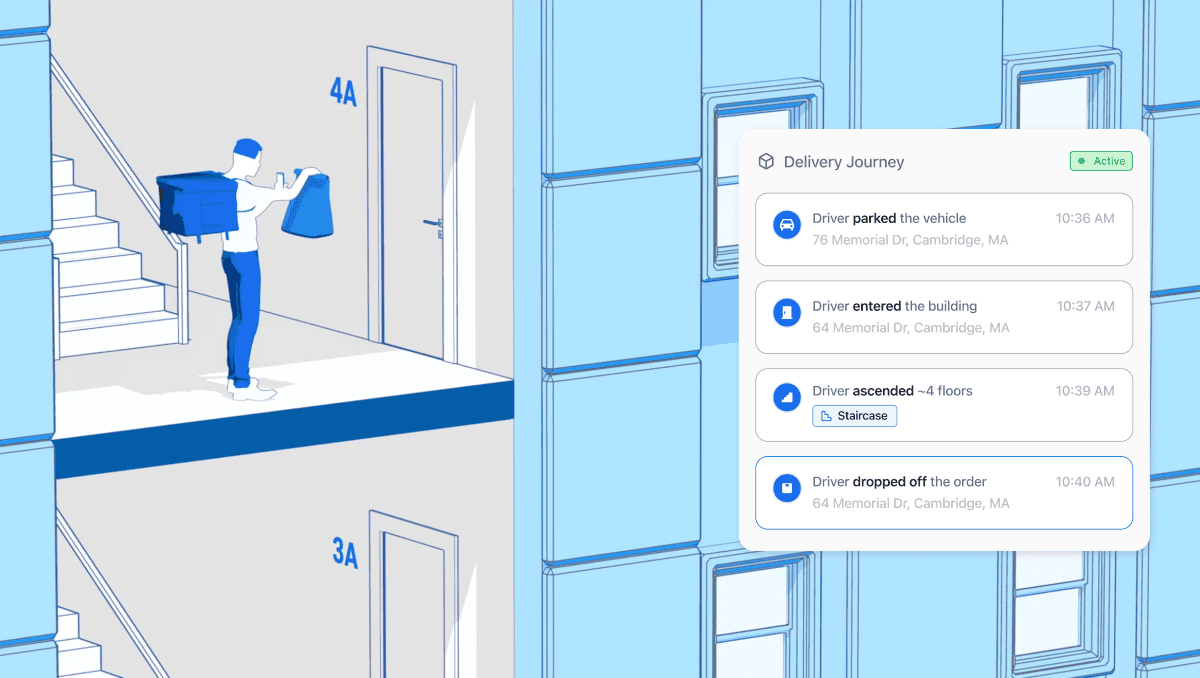
He also struck up conversations with delivery drivers in his spare time. What he learned from those conversations—and while delivering food and groceries himself—is that a lot of the information that is first given to drivers isn’t very clear or helpful. Buildings often have nonintuitive layouts, poor labeling, and elevators or stairs that are tricky to find. Another issue is security; the driver needs to know if they need a passcode, or if they’re expected to drop off food in the lobby.
Murarka also found that in many areas, particularly cities, the driver’s first language wasn’t English—yet another barrier.
“There’s a sequence of information a driver needs in advance for the process to go smoothly. They need to know where to park, where to enter the building, where to take the elevator or stairs—and knowing which of those options is available in advance can be crucial, if the delivery person is carrying a heavy load or has accessibility needs. It helps them to know in advance if they’re going to a high rise or low rise building and where in the building they’re headed.”
Emory Founders Catalyst Program
When Murarka arrived to Goizueta’s Startup Launch Accelerator (the precursor to the Techstars Emory Founders Catalyst program) the only thing he had firmly in hand was an idea. He’d previously started an e-commerce business, so he had some business sense—but like many inadvertent entrepreneurs, Murarka’s primary motivation at the time was that he was simply seeking to solve a problem for himself; no more 20 minute phone calls chasing down rogue sushi rolls.
“I wouldn’t even say it qualified as a ‘stage,’” says Murarka. “It was just an idea, a concept.”
What helped turn that concept into a real venture was the depth of support surrounding him—especially through Goizueta’s entrepreneurship community. The program gave him access to mentors and experts who pushed him to define the problem more clearly and think beyond a one-off fix toward a scalable business.
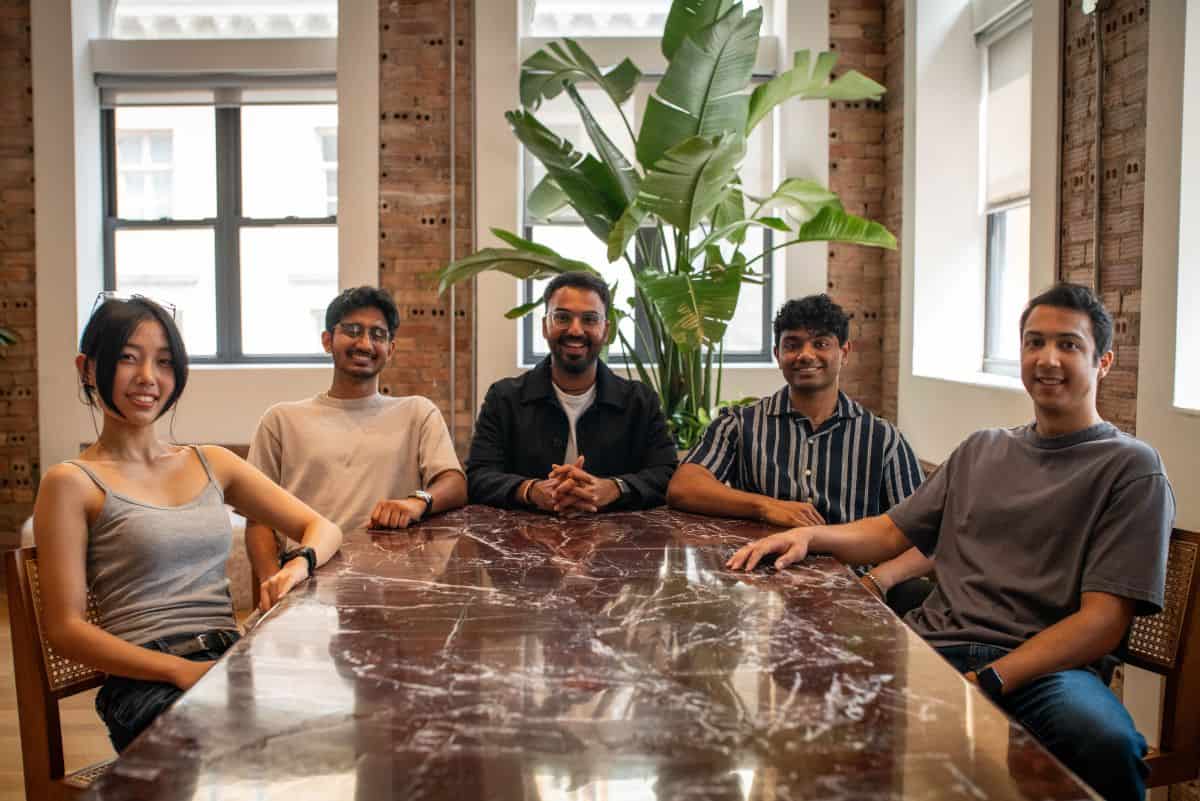
“The accelerator helped you focus on what problem you are solving and showed you how to quickly test your solution,” says Murarka. “If you’re going to fail, fail faster, and you arrive at your success sooner. They help you figure out where the value is and who your customer would be.”
That guidance came from multiple directions across the Emory and Goizueta ecosystem. Christy Brown was instrumental in the early days, asking the right questions and opening doors throughout the entrepreneurship network.
Brian Cayce, managing director for The Roberto C. Goizueta Center for Entrepreneurship & Innovation, spent significant time helping Murarka make connections, while Ben Garrett, director of The Hatchery, and other Emory staff helped broaden the circle of support around the company. The Emory Entrepreneurship Network board joined calls and offered practical guidance. Goizueta students moving through the accelerator became an important source of marketing feedback, helping Murarka pressure-test ideas in real time. And Emory alumni showed up in tangible ways as well: Kyle Wilson 09C invested after a pitch night, while Alex Watts 04C and other alumni continued to offer encouragement, insight, and support.
Says Cayce, “I wasn’t really sure if this was just his problem or a very big problem, but in first hearing his pitch, I wanted to lean in and learn more. Murarka has an infectious enthusiasm, and finding and supporting founders with his qualities is what the Center is all about. There was no doubt that we would encourage him to join the accelerator and pursue this concept. I am glad that others have seen it the same way and he has gained as much support and investment from others from so many circles.”
With his cofounder, Sheel Patel, and a growing network of Goizueta mentors, Emory staff, students, and alumni around him, Murarka began turning the idea into a company.
Beyond the Burrito: How Doorstep Could Save Lives
Without spilling too much of the secret sauce, Murarka reveals that Doorstep.ai utilizes “sensor fusion,” triangulating multiple sensory inputs to predict physical environments. His product generates revenue, but it also provides relief for many; people around the world—for reasons related to limited mobility or transportation access—rely on delivery services for food, groceries, medicine, personal care and other essentials, often in dense urban environments even more complex than those in the United States.

Murarka also realized that the scalability of his product could save lives. In an emergency, seconds matter—and while congealed ramen may be a bummer, delayed access to a first responder could prove truly tragic.
“I want to unlock this data for emergency services,” says Murarka.
“Imagine facing a medical emergency—your own or that of a loved one—while trying to guide an EMT to your front door. If we can get that driver to you even two minutes faster, that could make all the difference.”
“A Bias for Action”
Murarka is reluctant to offer advice; entrepreneurial pursuits are so individual, and he still feels like he is in the beginning stages of his journey.
Still, he can say with confidence what he doesn’t regret about his own process.
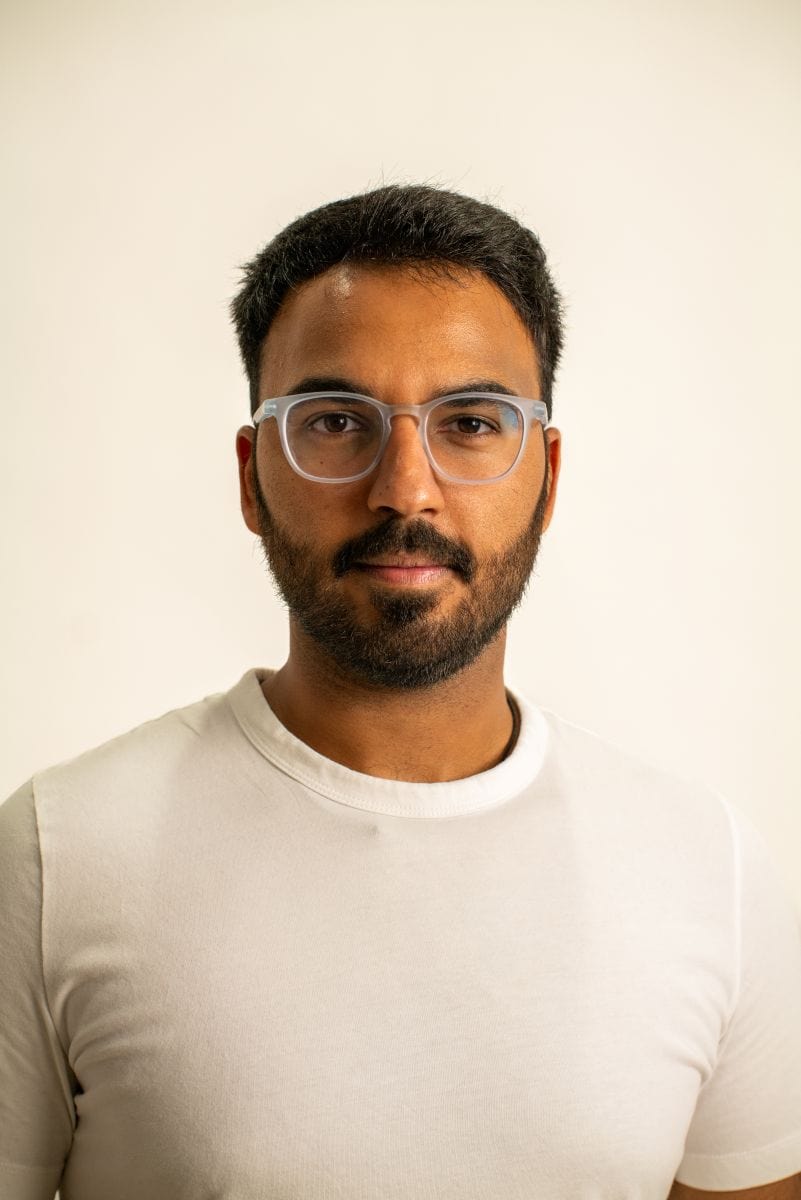
“I’m grateful I got started without waiting. You’re always thinking about whether or not you should start a company, and there’s a temptation to wait until you have more experience. Having a bias for action has helped me go a long way.”
“I’m also so grateful I made use of the accelerator and the Goizueta and Emory entrepreneurship community as soon as I did,” he says. “They helped me get answers faster; they shortened the span of the feedback loop, and they pushed me to untangle the logistical knots because you’re obligated to circle back to them within a week— it forces momentum.”
Murarka also emphasizes that the evolution of a product is never finished.
“I still stop and talk to delivery drivers. Sometimes I approach them in the elevator, which often takes them by surprise. I was supposed to meet friends for dinner the other day and I spent 45 minutes talking to a driver outside the restaurant.”
“I’m obsessed with it—I still am.”