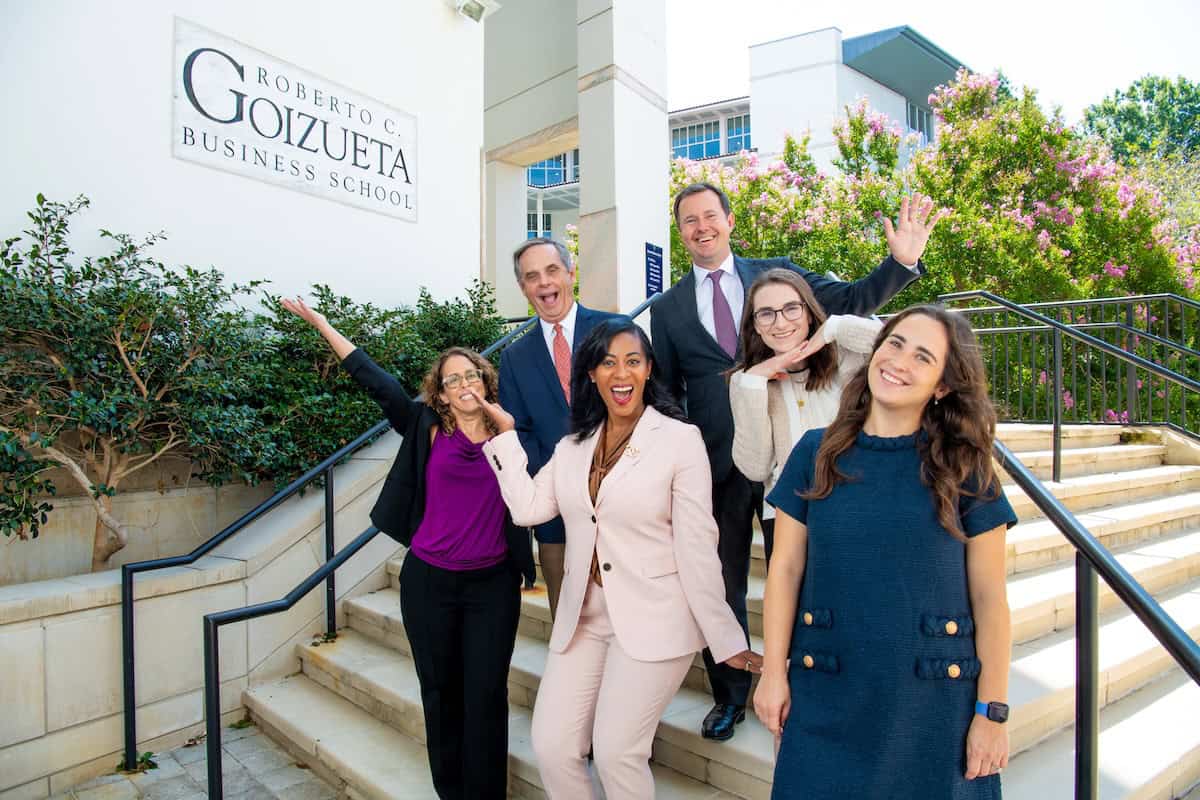

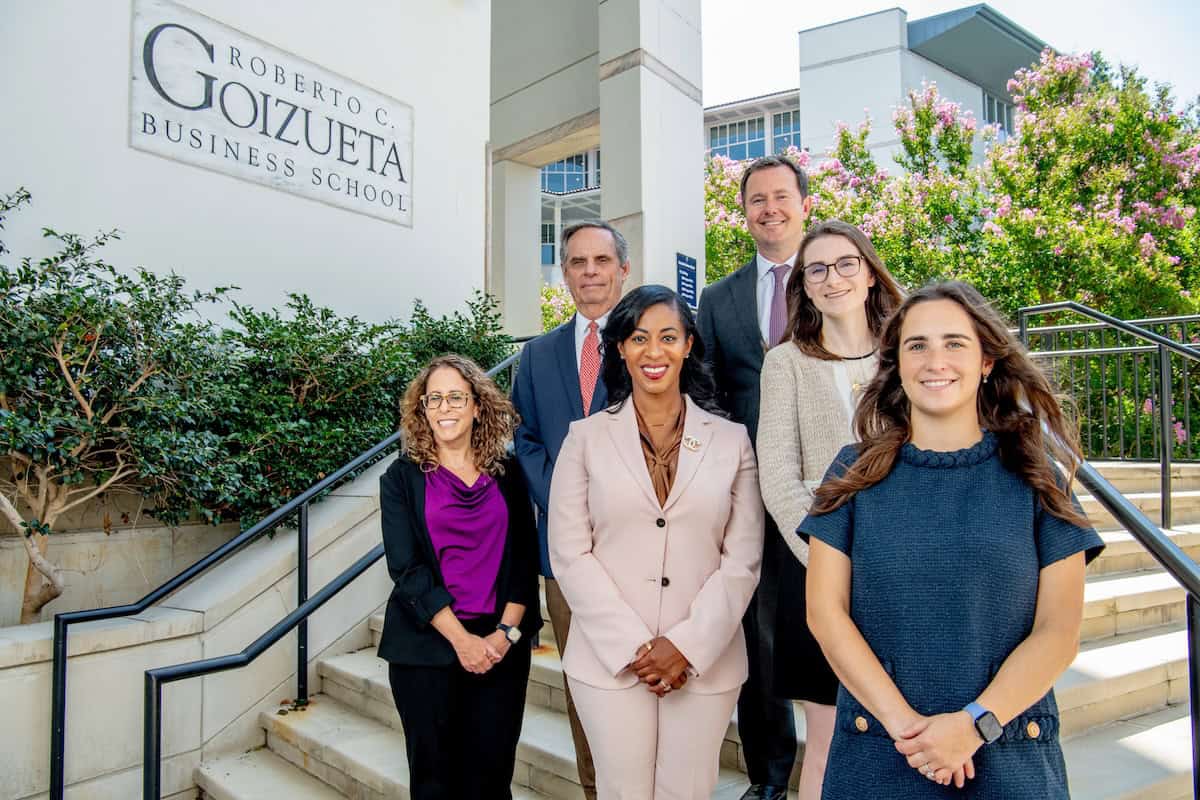
As a new academic year begins, Goizueta Business School welcomes six new faculty members whose expertise reflects the breadth—and rapidly evolving nature—of business today. They bring with them new perspectives to Goizueta’s classrooms, research community, and connections with industry.
Their paths to Goizueta are equally varied. This year’s group includes scholars examining everything from AI-driven scientific discovery and climate policy to the forces that shape how people work and thrive within organizations, as well as experienced leaders bringing deep connections to industry and the Atlanta business community. One familiar face is also taking on a new role, moving from years of supporting Goizueta students and the BBA program into the faculty.
“Goizueta’s faculty are at the heart of what makes this school such a special place,” says John H. Harland Dean Saby Mitra. “This year’s new faculty bring an exciting range of expertise and perspectives that will strengthen our research, enrich the classroom experience for our students, and deepen our connections to the business community. As we look to the future, attracting talented faculty like these will be essential to building on Goizueta’s tradition of excellence and expanding our impact in Atlanta and around the world.”
Goizueta is pleased to introduce its newest faculty members:
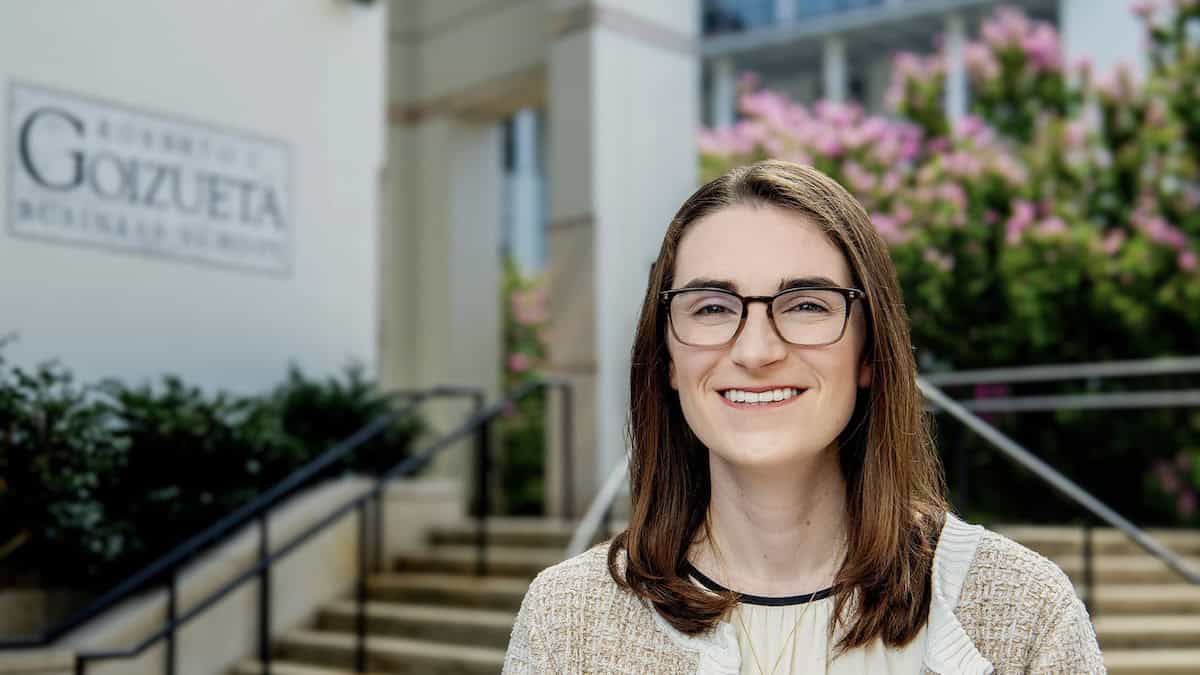
Mackenzie Feinberg: Assistant Professor of Accounting
What inspired you to join the faculty at Goizueta?
I love that the Goizueta faculty have an incredible range of research and teaching interests. I am constantly learning from my peers! Moreover, the strong connection to the Atlanta business community and the world-class MBA program helps keep our work focused on issues that matter to practitioners.
What are you currently working on, and why is it important in today’s business landscape?
My work explores how managers and employees can best work together to achieve organizational goals. I am currently working with a large regional bank to help evaluate and revitalize its sales and service team incentive programs. Together, we are exploring how and when to integrate prosocial rewards and elements, such as donations to charities on an employee’s behalf, into individual and group initiatives. Today’s employees want their employers to be responsive to their needs as whole individuals and are looking for seamless integration between work and life. Firms that can design effective contracts to meet these needs will inspire their workforce.
What’s something unique that you’d like colleagues and students to know about you?
I am one of four siblings, and three of us had children last year (2025), all choosing the same middle name in honor of my late grandmother!
If you could sum up your teaching style in three words, what would it be?
Collaborative, challenging, and creative!
What’s one book, podcast, or article you think every business student should read or listen to?
“Atomic Habits” by James Clear. It is one of the most actionable behavioral science books on my shelf!
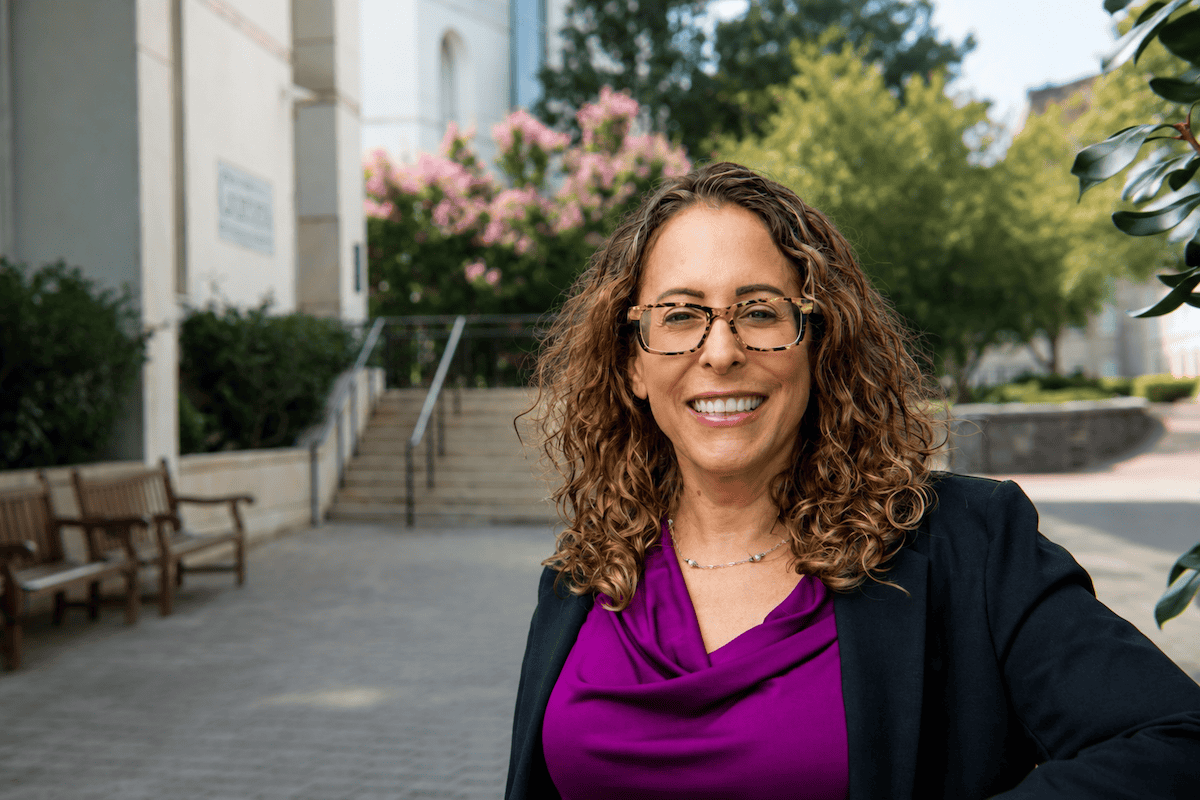
Jessica Lowy: Assistant Professor in the Practice of Organization & Management
What inspired you to join the faculty at Goizueta?
My path to becoming a faculty member is fairly nontraditional. I’ve been at Goizueta for the past 16 years, serving as a staff member in the Bachelor of Business Administration Program Office. Through these roles I have supported undergraduate students in a variety of capacities, initially in admissions and more recently as Assistant Dean of BBA Advising and Academic Affairs and co-instructor for our required Personal Development course. As Assistant Dean, I also had the opportunity to work closely with faculty on matters of advising, curriculum, and policies. I am passionate about the Goizueta community and I’m excited to bring the perspectives I’ve gained from working across the Bachelor of Business Administration Program to a faculty role, through which I can continue contributing to our development of our students as the next business leaders.
What are you currently working on, and why is it important in today’s business landscape?
As I transition from my staff position to one as a faculty member, I am focused on the challenges facing our students in today’s business environment and how our Business Communication Strategy course plays a pivotal role in their preparation, not just for their coursework but for their professional journeys beyond Goizueta. While communications skills, the ability to work well in team-based environments, and the capacity to work through ambiguity have always been critical to success, the business landscape is changing rapidly, particularly in regards to technology and AI, requiring students to be adaptable in order to be effective decision-makers within organizations.
What’s something unique that you’d like colleagues and students to know about you?
I’ve been going to Dragon Con since 2012. It’s a big convention that takes place in downtown Atlanta each Labor Day weekend, attracting 75,000 attendees from throughout the world. People dress up in various cosplays based on their favorite characters and genres. It’s a fun event for both adults and kids, with character meet and greets, actors from various movies and TV shows, and a parade. Some of my previous cosplays have been Lydia Deetz from Beetlejuice, Louise from Teen Witch, and when I was pregnant, a character from Alien with an alien coming out of my stomach (I think that was the fan favorite). My son has dressed up as Knuckles from Sonic and Spider Man. It’s great people watching even for those who don’t part in the con itself!
If you could sum up your teaching style in three words, what would it be?
Equity-minded, supportive, and adaptable.
What’s one book, podcast, or article you think every business student should read or listen to?
I would recommend “Blink: The Power of Thinking Without Thinking” by Malcolm Gladwell. In Business Communications, I’ll be discussing the concept of thin-slicing, how individuals form impressions rapidly, in the context of how we communicate. We interpret behaviors such as facial expressions, gestures, posture, tone of voice, and speech unconsciously, and through that rapid processing, we perceive qualities such as confidence, credibility, enthusiasm, and preparedness. It’s important that business students understand the psychology behind decision-making. In Blink, Gladwell focuses on the ways in which our brains use heuristics to make efficient decisions to reduce our cognitive load in an environment replete with variables, as well as the ways in which these processes may unintentionally result in cognitive biases that impact the effectiveness of our decisions. In addition, Gladwell is a great storyteller, providing vivid and easily accessible examples that apply these concepts, which make for a fun read.
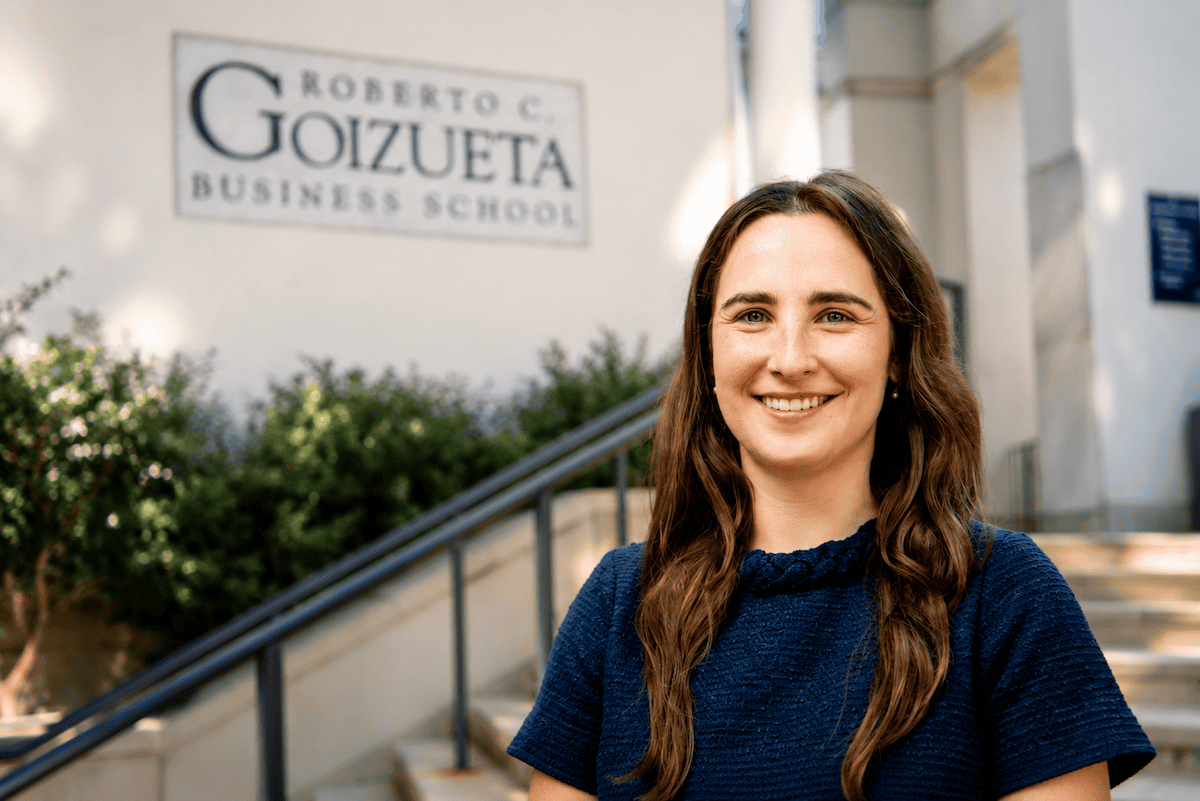
Joanna Harris Murphy: Assistant Professor of Finance
What inspired you to join the faculty at Goizueta?
I am excited to join Goizueta because of its research environment. The breadth of research interests in the finance group is a big draw, since my own work sits at the intersection of several areas of finance. Equally important is the collaborative culture I observed during my visit. Much of my time was spent discussing research, and I came away with the impression that this is a community where faculty engage seriously with each other’s work. I am looking forward to learning from my new colleagues and contributing to that community.
What are you currently working on, and why is it important in today’s business landscape?
My research studies how climate regulation affects firms and financial markets. Climate and environmental policy is a rapidly evolving area of regulation, with real consequences for production, investment, and asset prices. My work combines empirical and theoretical approaches, with a particular focus on what financial markets can tell us about the effects of climate policy and how regulation shapes investor and firm behavior.
My job market paper explores these questions in the context of U.S. state-level climate policy. These policies vary widely not just in stringency but in form, such as emissions caps, renewable standards, and efficiency requirements. This makes it difficult to compare their impacts in common quantitative terms. I address this by inferring the effective cost each policy imposes on affected firms, using equity returns around enactment. These estimates put policies on a common scale and feed into a structural model that studies their effects on production, emissions, and economic activity across regions. Understanding which policies impose meaningful costs, how those costs are distributed between firms and workers, and how firms adjust in response is essential for evaluating decentralized climate policy.
A related line of work, with coauthors, examines how sustainability disclosure rules shape capital allocation in the mutual fund market. We use the European Union’s Sustainable Finance Disclosure Regulation, which requires funds to classify themselves according to their sustainability characteristics, to study the effects of mandatory ESG disclosure. Our focus is on how different types of investors respond. We find substantial heterogeneity: institutional investors respond more strongly than retail investors, and investors located in countries with greater trust in environmental labels respond more strongly than those in low-trust countries. These results suggest that the effects of sustainability disclosure depend not only on the rules themselves but also on the preferences and beliefs of the investors they affect.
What’s something unique that you’d like colleagues and students to know about you?
My husband and I are working our way through the U.S. national parks. We are at 27 of 63 so far, with stops ranging from the Everglades to Denali. At home, we have a 100-pound dog named Moose. I am also a member of a bean club, which sends heirloom beans and recipes each quarter.
If you could sum up your teaching style in three words, what would it be?
Rigorous, applied, accessible.
What’s one book, podcast, or article you think every business student should read or listen to?
The podcast “Capitalisn’t,” hosted by Bethany McLean and Luigi Zingales (one of my advisers at Booth). It takes current events in business and finance and asks careful, often skeptical questions about whether markets are working the way they should be, and what role regulation, incentives, and corporate power play in the outcomes we observe. I think it is especially valuable for business students because it shows how questions about markets, regulation, and corporate behavior are often more complicated than they first appear. It manages to explain complex issues clearly, without losing the nuance that makes those issues interesting.
Joel Murphy: Goizueta Distinguished Industry Chair in Real Estate; Executive Director of the BL Harbert Real Estate Center
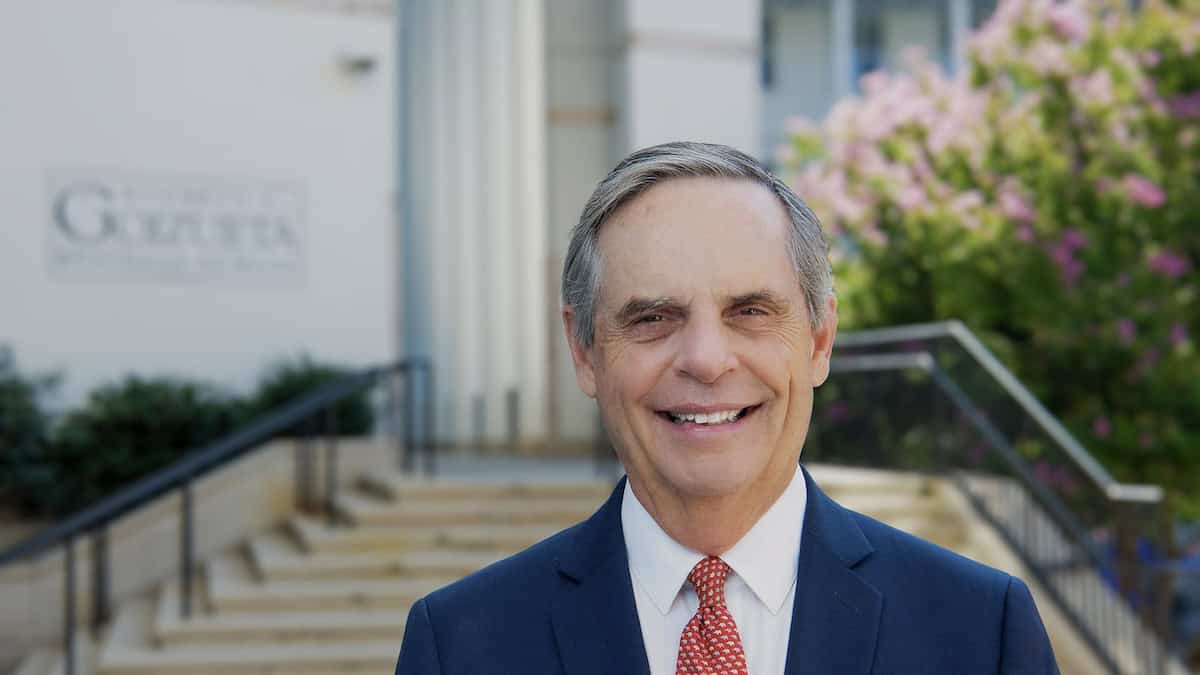
What inspired you to join Goizueta and lead the BL Harbert Real Estate Center?
The opportunity to effectively “build a real estate business” inside the well-respected brands of Goizueta and Emory, and to be housed in Atlanta, one of the great real estate markets in the country (and even the world).
What excites you most about the opportunities you’ll create for students through the Center?
I get great energy from young people and I’m most excited about the opportunity to share with them my industry contacts, industry knowledge and experiences, career path, and relationship building strategies and skills so that they are prepared to make meaningful impacts in a rapidly evolving real estate marketplace as technology, capital flows, and demographic shifts redefine how and where we live, work, and invest. The opportunity to mentor the next generation of real estate leaders and help them gain the practical skills and perspective needed to lead with integrity and vision is very meaningful to me.
What’s something unique that you’d like colleagues and students to know about you?
My Italian maternal grandmother, Marguerite, was a “runaway bride.” She ran away by herself from an arranged marriage in southern Italy to the United States in 1917. She found herself in south Philly where she met the love of her life, my grandfather Michael, a good Sicilian boy. Knowing all of this famiglia italiana has inspired in me a great love of all things Italian…the people, the food, the wine, the music, the history, the places, and the language.
If you could sum up your leadership or mentoring style in three words, what would they be?
Aspirational, Collaborative, Connector
What’s one book, podcast, or article you think every aspiring business or real estate leader should read or listen to?
“Preeminence: What it Means and How to Sustain It” by Glen Jackson.
Alexander Oettl: Acting Professor of Organization & Management
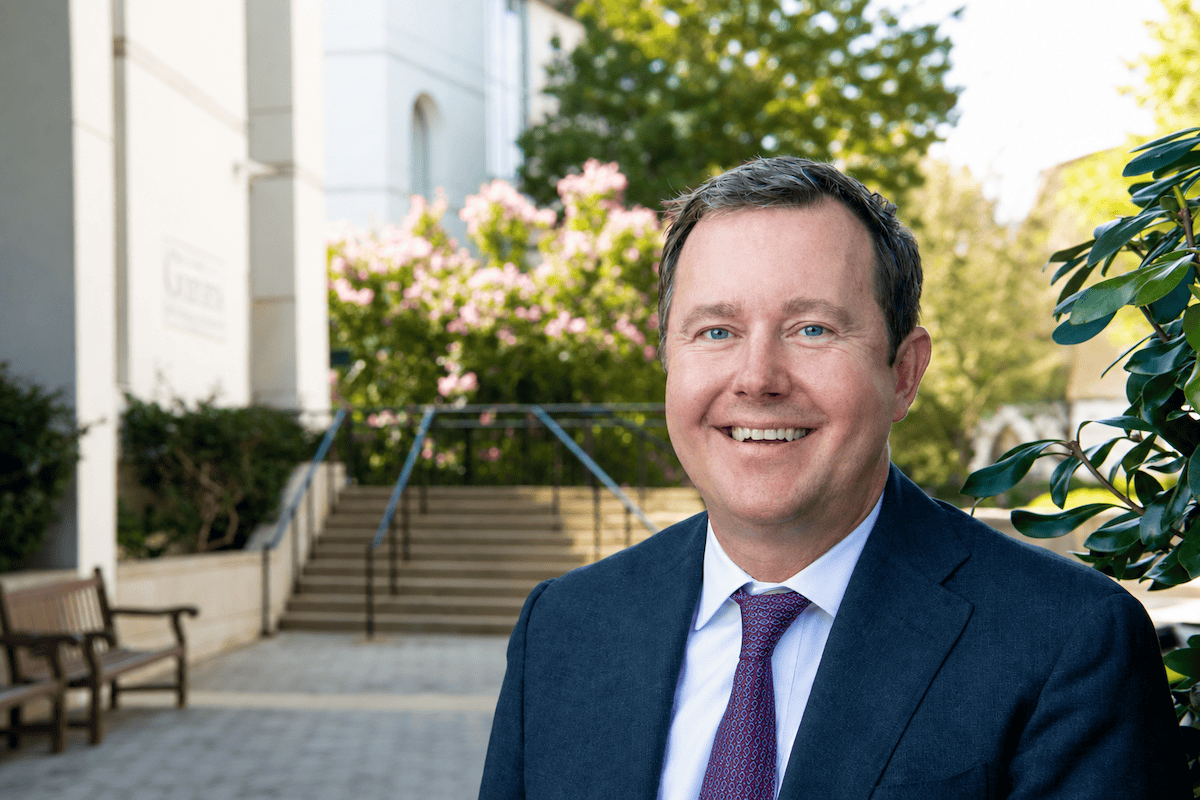
What inspired you to join the faculty at Goizueta?
I’m a scholar of innovation, that is, what drives the production of new ideas and how those ideas spread across people, firms, and regions. A lot of that work has focused on university science: star scientists, knowledge spillovers, and more recently how AI is accelerating scientific discovery. Emory is home to a large research enterprise, especially in medicine and public health, but a lot of the science Emory produces never makes it from the lab to the broader market. Closing that gap is where my research agenda is going. What really got me excited, though, was the opportunity to become the inaugural Goizueta Chair in Entrepreneurship and with it the ability to help grow the entrepreneurship ecosystem at Emory.
What are you currently working on, and why is it important in today’s business landscape?
I’m working on two main projects at the moment. The first is on AI in science. Long-run economic growth comes largely from the production of new ideas, which makes accelerating that process arguably AI’s most important potential application. And yet we still don’t have a clear picture of where or how it will actually materialize. In a series of papers, I’m building frameworks to map where AI is most likely to accelerate scientific discovery, where human judgment remains critical, and what skills and organizational changes organizations need to make in order to capture the gains. For business, this is what will determine which industries see an acceleration in innovation over the next decade, and where the next wave of high-growth companies will form.
The second project is on the emerging space economy. The cost of getting to orbit has dropped by a factor of ten over the last decade, and an entirely new commercial sector is forming on top of that. Hundreds of new companies are building satellites, providing launch capabilities, offering in-space services, and even attempting in-space manufacturing. I’m studying how the entrepreneurial ecosystem around this industry is taking shape. Both projects are really about the same question: where the next wave of growth will come from, and which firms are best positioned to take advantage of it.
What’s something unique that you’d like colleagues and students to know about you?
I carry three passports: Canadian, German, and American. I was born in Toronto, finished high school in Berlin, and have now called Atlanta home for 17 years. Living across three countries has given me an appreciation for the pros and cons of each country. Seeing that the same problem can be tackled differently is probably what pulled me toward studying innovation.
If you could sum up your teaching style in three words, what would it be?
Socratic, Rigorous, Curious.
What’s one book, podcast, or article you think every business student should read or listen to?
I’ve got two recommendations. First, the podcast “Conversations with Tyler.” The economist Tyler Cowen is one of the best interviewers out there, forcing his guests to actually think rather than simply recite talking points. Second, the “Stratechery” newsletter by Ben Thompson, is one of the clearest writers on technology and business strategy I’ve read. Both are great places for students to keep up with the latest thinking in business.
Ella F. Washington: Professor in the Practice of Organization & Management
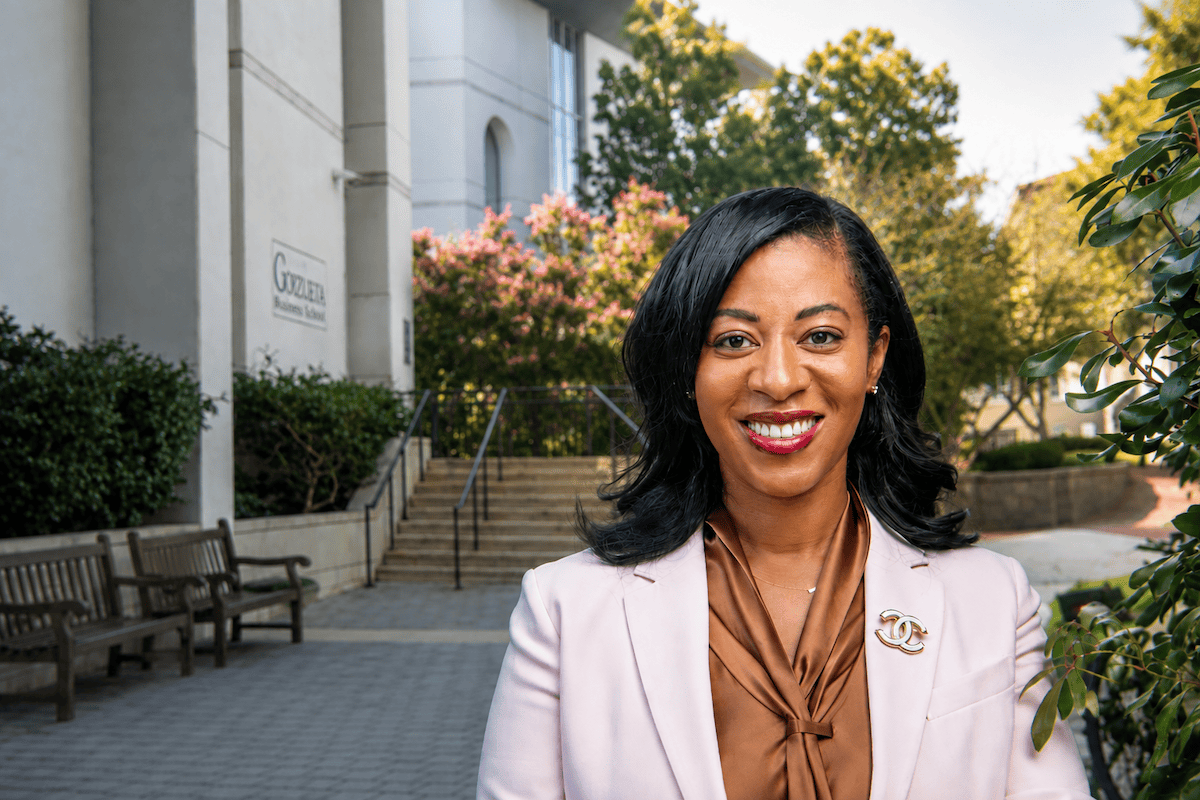
What inspired you to join the faculty at Goizueta?
I have always been drawn to environments where I can make a meaningful impact on how people experience work. Goizueta’s commitment to principled leadership and its global, diverse student body felt like the perfect fit for the next chapter of my career. After nearly a decade at Georgetown, I was ready to bring my research and teaching to a new community, and Atlanta is a city that reflects the dynamism and diversity I study every day. I am excited to be part of a business school that values both academic rigor and real-world relevance, and I look forward to contributing to the culture here.
What are you currently working on, and why is it important in today’s business landscape?
My work centers on the unspoken rules that shape who thrives and who struggles in organizations. I recently published my second book, “Unspoken: A Guide to Cracking the Hidden Corporate Code,” which gives professionals the tools to navigate the invisible dynamics of power, politics, and belonging at work. I am also actively consulting with companies across industries on how to build cultures where diverse talent can genuinely succeed. In today’s business landscape, organizations are competing for top talent while navigating increasing polarization and complexity. As AI transforms how we work, leaders who understand the human side of business, including how to build trust, foster connection, and create cultures where people do meaningful work, will have the greatest competitive advantage.
What’s something unique that you’d like colleagues and students to know about you?
I am a runner. I have completed four half marathons, and the discipline of training mirrors a lot of what I teach about careers: it is about pacing yourself, showing up on the hard days, and trusting the process.
If you could sum up your teaching style in three words, what would it be?
Empowering, Engaging, Evidence-based
What’s one book, podcast, or article you think every business student should read or listen to?
I would recommend the podcast Code Switch. It does an incredible job of exploring how identity show up in everyday life, including the workplace. For business students, it builds the perspective-taking and cultural fluency essential to leading today and tomorrow’s teams and making thoughtful decisions in a complex world. And of course, I would be grateful if they also picked up a copy of “Unspoken”!
Goizueta faculty apply their expertise and knowledge to solving problems that society—and the world—face. Learn more about faculty research at Goizueta.