
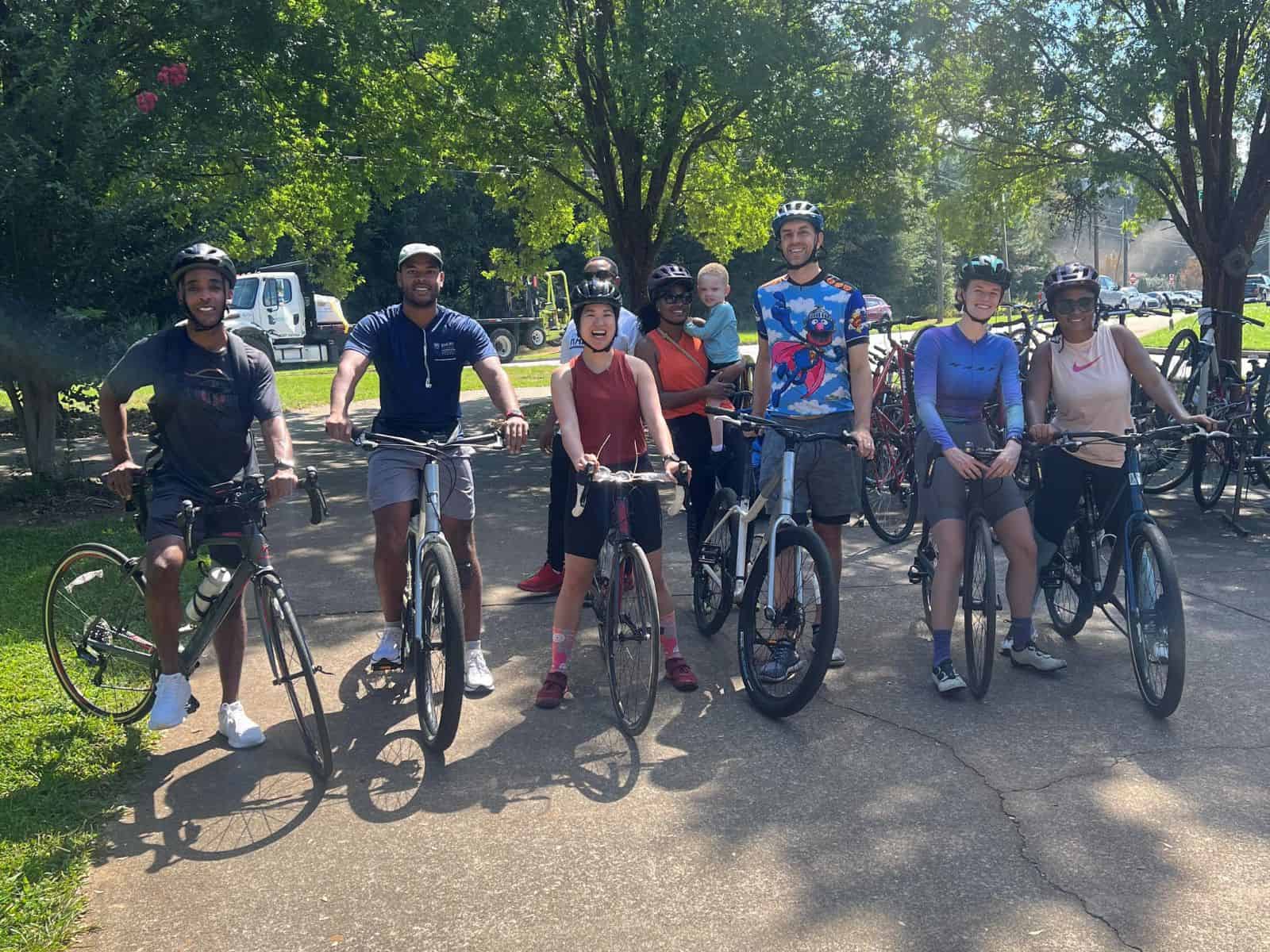
This past August, during the inaugural month-long Tour de Goizueta competition, a group of 185 full time MBA students, faculty, staff, and alumni collectively logged 26,664,492 steps, the equivalent of 13,300 miles—halfway around the earth.
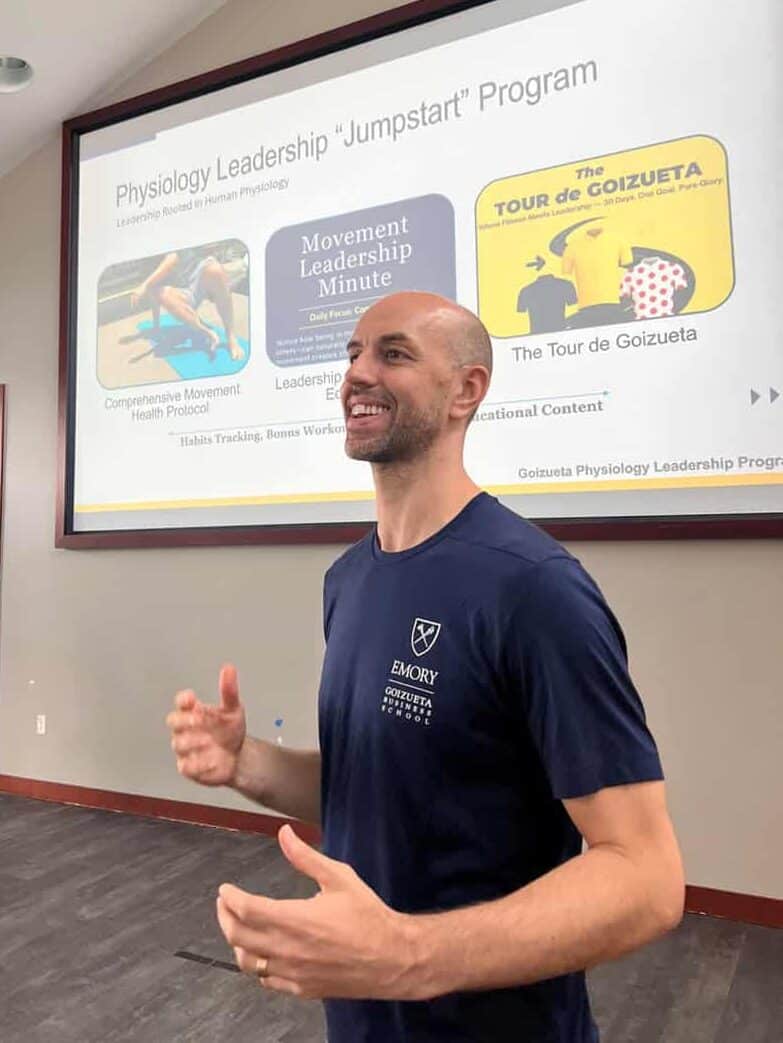
An outgrowth of Goizueta’s Physiology and Leadership Program, which began in 2022, the tour was designed and led by Eric Holshouser 21MBA 21DPT, adjunct professor at Emory School of Medicine and affiliate faculty at Goizueta Business School.
In addition to creating a sense of community during the full-time MBA program’s onboarding experience, the goal of the tour, notes Holshouser, is to give students, faculty, staff, and alumni “the academic knowledge and culture to be intelligent, healthy, and centered leaders.”
Lessons from the World’s Most Demanding Race
Like the Tour de France—the infamously grueling three-week cycling competition that tests the endurance, strategy, and teamwork of the world’s elite riders—the Tour de Goizueta is designed as a team-based challenge with multiple paths to success.
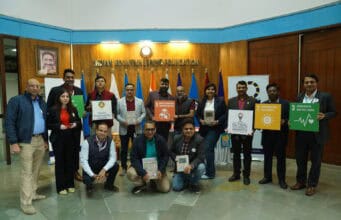
In the Tour de France, cyclists compete not only for overall victory, but also for distinction in specialized categories, with sprinters, climbers, and all-around athletes earning points toward the coveted green, polka dot, and yellow jerseys based on their individual strengths and team strategies.
Similarly, the Tour de Goizueta rewards participants across a range of achievements—from the most total steps, to the most exercises or stairs climbed—recognizing that leadership, like elite performance, is built through diverse strengths, sustained effort, and collective commitment.
Participants can track and compare their progress via an app which also gives them access to resources—everything from content regarding movement, stress, sleep, and healthy recipes to daily minute-long leadership-themed videos. “It’s a kind of one stop shop,” explains Goizueta’s Director of Development, Garrett Webb, who took part in the tour this past August.
Yaa Agyeman-Yeboah 26MBA, one of the students who participated in the competition, posted on LinkedIn: “One of my favorite things about being at Emory University-Goizueta Business School is the focus on developing us as whole humans. Our day jobs can easily turn into long hours at a desk, but Goizueta reminds us that movement, balance, and well-being are just as important as strategy and spreadsheets.”
Rethinking Leadership in a Desk-Bound World
Agyeman-Yeboah’s post resonated with Holshouser. Before earning a dual degree at Emory University’s School of Medicine and Goizueta Business School, Holshouser, who also has a master’s degree in civil engineering, worked at an engineering firm.
He spent so much time sitting at his desk that his well-being declined. In search of a solution, he joined the company’s wellness committee. Though a step in the right direction, it wasn’t enough for Holshouser. He decided to change careers.
I wanted to make an impact on population health and especially health in the workplace.
Eric Holshouser
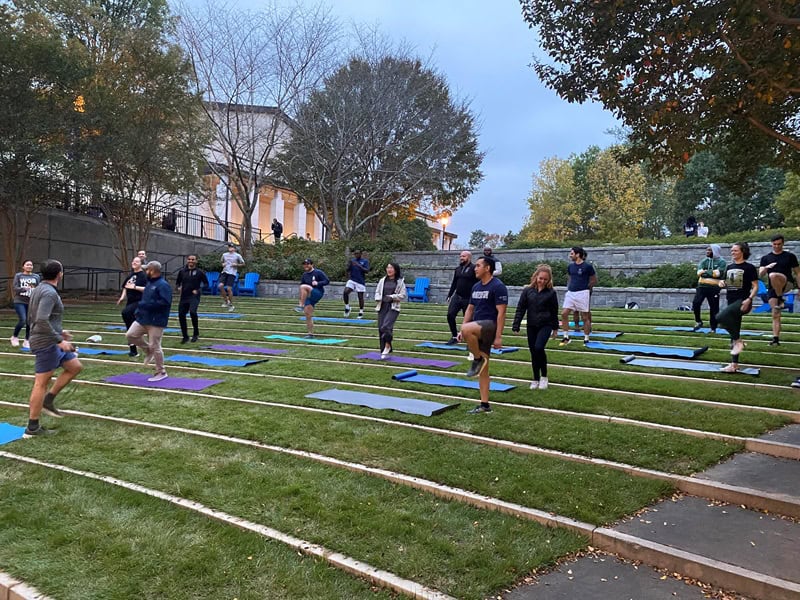
While pursuing his MBA, Holshouser interviewed students about their health and the trajectory of their lives for a project in Associate Professor of Organization & Management Wes Longhofer’s Business & Society class. One of the big takeaways from those interviews, Holshouser says, was that roughly half the students were dissatisfied with their health and well-being.
That prompted Holshouser to do a directed study with Steve Walton, professor in the practice of information systems and operations management. During the study, he researched the link between movement and cognitive performance. “It evolved into a leadership piece as well,” Holshouser adds. His directed study gave him the idea to create the Physiology and Leadership Program at Goizueta. Holshouser approached Brian Mitchell, associate dean of Full-Time MBA Programs, about his idea.
“We began working with Eric on this as the university defined ‘student flourishing’ as a priority,” explains Mitchell. “For our full time MBA students, we focused on mental and physical wellness programming as student flourishing programs.”
The results continue to exceed our expectations as our students participate at high rates and consistently comment on how unique and helpful Eric’s activities are.
Brian Mitchell, Associate Dean of Full-Time MBA Programs
Currently, the main component of the program takes place during onboarding—the first month the full-time MBA students are on campus. Since then, Holshouser has continued to lead workouts with the students. Next on deck for the Physiology and Leadership Program is the New Year’s Challenge, which will help participants, “dive deeper into how their physiology drives intelligence and performance as they prepare for internships and graduation,” Holshouser explains. This year, the challenge will be open to alumni, faculty, and staff. He’s also planned a friendly soccer match between the first- and second-year MBA students involved in the program.
Student-Led Insights Driving Program Growth
With the goal of improving the delivery of relevant information and boosting the program’s community-building aspects, five current full-time MBA students, Maddie McMurray 26MBA, Martin Gravely 26MBA, Michael Levin 26MBA, Braden Skirpak Gordon 26MBA, and Surabi Srinivasan 26MBA are working on a directed study with Holshouser.
Martin pointed out that while the leadership aspects of the program are important, the program can’t maximize its effect without commitment from participants. “Culture and the community are how we get buy in,” Gravely explains.
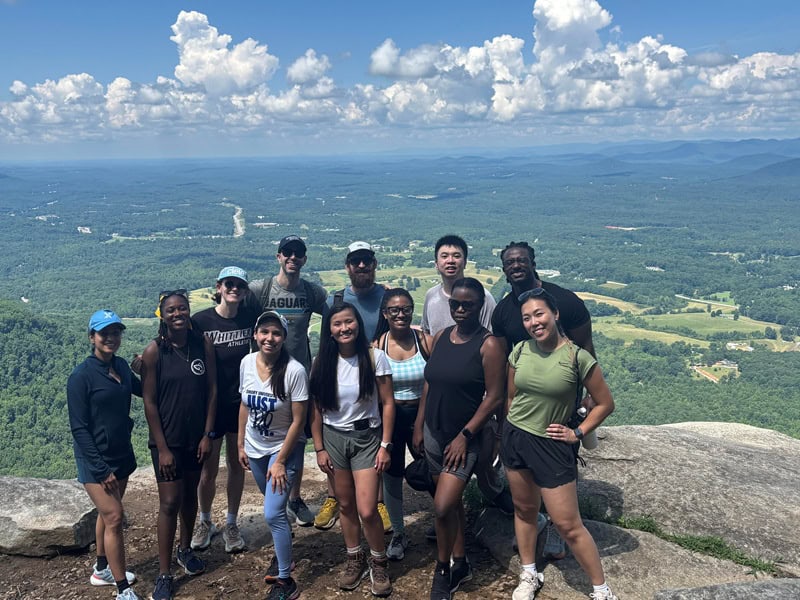
McMurray adds, “When building community, establishing trust is important.” She and Gravely agree that the more the Physiology and Leadership Program can cultivate a sense of community and trust, the more willing participants—students, faculty, staff, and alumni—will be to share moments in their lives and careers when things were difficult and how they navigated those challenges. Both believe that sharing these experiences will help participants grow as individuals and as leaders.
“Crafting the Tour de Goizueta into a directed study allows our students to strengthen and formalize the program with faculty oversight and to expand the positive impact on our student body,” explains Mitchell. “The Tour de Goizueta is a great initiative, and an example of how our alumni remain engaged for the betterment of the MBA program.”
The Future of Physiology and Leadership
As excited as Holshouser is to showcase the links between human physiology and leadership to inspire tour participants to make their health a priority, he adds that it’s “the opportunity to build community around fitness and leadership that spans generations at Goizueta” that inspires him to create the best possible program he can.
A key element of that will be “having some type of framework that helps people stay connected,” Holshouser says.
It’s really important for the students. It’s also great for the school because there aren’t always those strong connection points to keep us alumni engaged.
Holshouser believes Goizueta’s Physiology and Leadership Program and the tour could become “a national model. Not just how we make the Goizueta experience amazing, but—in the future—how can it be exported to other schools and organizations?”