
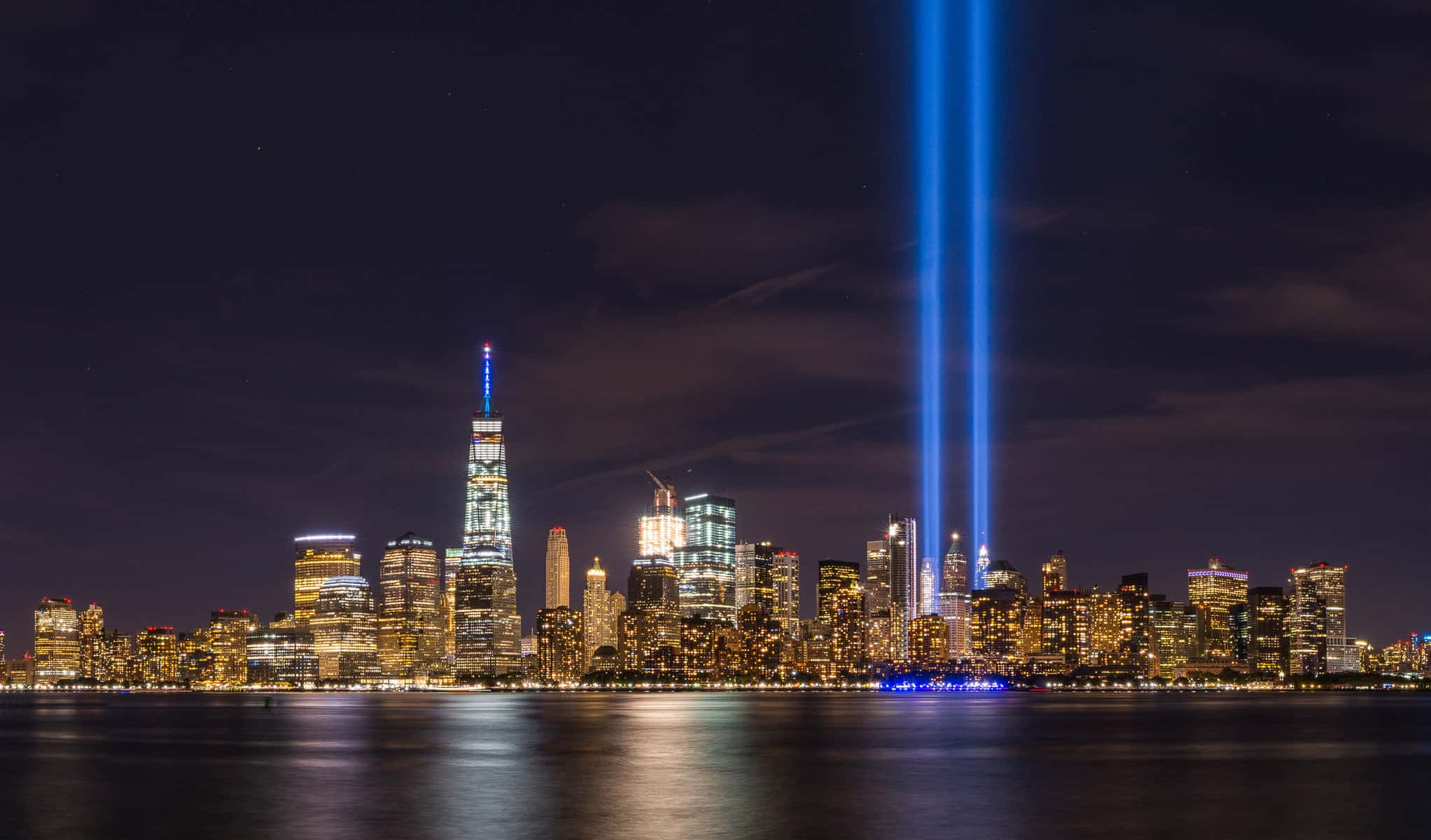
Twenty-five years after September 11, members of the Goizueta community reflect on the people, places and moments that have stayed with them through the years.
A Message from Dean Saby Mitra
As we mark the 25th anniversary of September 11, I wanted to take a moment to reflect on the attacks, their aftermath, and the people and communities whose lives were changed in ways that continue to be felt today. For many of us, the memories remain vivid, even as a younger generation has come of age knowing September 11 primarily as a moment in history.
At Goizueta, September 11 is part of our own community’s history. We lost two alumni in the attacks: Ehtesham Raja 98MBA, who was at the World Trade Center, and Todd Reuben 83BBA, who was aboard American Airlines Flight 77. We also have alumni and members of our broader community who experienced that day firsthand and whose lives were forever changed. Their stories are an important part of how we remember.
When I think about September 11, what stands out most is the courage of ordinary people in extraordinary circumstances. I think about the firefighters who walked into the buildings to save lives, and the passengers on the hijacked planes who fought back even when they knew the odds were against them. I think, too, about the many people who helped strangers, cared for one another, and came together in the days and weeks that followed.
Twenty-five years later, that sense of community still feels worth remembering. So does the resilience that followed. New York rebuilt. The country moved forward. And millions of people continued to live their lives, raise their families, build businesses and communities, and look toward the future.
But moving forward does not mean forgetting. The thousands of people who died were parents, children, siblings, friends, colleagues, and neighbors. Among them were members of our own Goizueta community.
I am grateful to those who made the ultimate sacrifice that day, to those who ran toward danger to help others, and to the members of our armed forces and intelligence communities who have continued to serve and protect others.
As we mark this anniversary, I hope we can hold onto both the personal and the broader lessons of September 11—the importance of looking out for one another, the strength that comes from community, and the resilience that helps us move forward through difficult times. Remembering also means acknowledging that the years that followed were complicated, and the way we respond to moments of crisis matters.
The reflections below offer a glimpse into the many ways September 11 has stayed with members of the Goizueta community.
Reflections from the Goizueta Community
September 11 is remembered differently by each person who experienced it. For some, the memories are of New York. For others, they are of classrooms, airports, family members, friends, or simply the profound realization that the world had changed.
We asked members of the Goizueta community to share what they remember and what September 11 continues to mean to them.
Brian Mitchell
Associate Dean, Full-Time MBA Programs and Goizueta Global Strategy and Initiatives
On Monday, September 10, 2001, I boarded my flight to New York as I did every Monday morning. I was an engagement manager for a consulting firm working with a pharmaceutical company client in midtown Manhattan. It was routine. The next day, everything changed.
In the chaos of 9/11, I remember the leadership of the senior partner on our project, William DeMarco. He gathered our team, acknowledged that we were all in shock, afraid, and confused, and reminded us that our client’s employees were local and likely knew people directly affected by what was happening.
Then he told us to stop what we were doing and “go find someone to help.” It didn’t matter who or how. Just find someone who needed something and help them. Not work. Personal.
It was a remarkable demonstration of how a leader manages a team’s, and their own, self-orientation. That is, a leader’s ability to focus on the needs of others over their own needs. It is one of the keys to demonstrating true empathy, and true empathy is one of the most elusive aspects of leadership.
We spent the rest of the week making sandwiches and passing them through gaps in the fences near Ground Zero to first responders. William was right there with us, indistinguishable from the most junior person on the team.
After that week, any of us would have done anything for William. And now, the most important thing I try to do to honor his memory and the lesson he taught us on 9/11 is operate with that same level of empathy in moments of calm and moments of crisis. Focusing on others more than I focus on myself. He gave me a gift that I’m still grateful for to this day.
Wes Longhofer
Associate Professor of Organization & Management; Senior Director, Center for Faculty Development and Excellence; Assistant Vice Provost for Faculty Affairs
I was in college when the attack happened. I was running late for class and noticed a crowd forming around the television in the lobby of my dorm. By the time I got to class, word got around about what had happened. We sat in silence in our seminar room for a few minutes when the professor said, “We don’t have to be here right now.” We took a vote and decided to stay. We wanted nothing more than to be in community in that moment. And no community provided more comfort in that moment than our classroom.
The event was a grim reminder that what connects us globally can also divide us and tear us apart. It is also hard not to mention the two long wars or the broad distrust and suspicion that was sowed in the immediate aftermath of the attacks. However, it also revealed the resiliency and resolve of those who, through all of the violence and tragedy, still found ways to love and respect one another despite vast differences.
Jackie Conner
Associate Dean of Executive MBA and Evening MBA
The main lesson I learned from September 11 was that you cannot live in a state of fear. About three weeks after the September 11 attacks, I was supposed to fly from Atlanta to Los Angeles. I vividly remember being in the airport and having a panic attack before getting on the plane. I was terrified about flying in fear that the plane was going to be hijacked and crash into a building. I had the flight attendants remove my luggage from the plane, and I went back home. Well of course, the flight went on to Los Angeles without me, and I would have landed safely. Instead, I missed out on an important opportunity because I allowed fear to overwhelm my emotions and paralyze my actions. After being depressed for two weeks after the event, I made a conscious decision: I would no longer allow fear to govern my life. I committed my spirit to living without fear. Life provides many opportunities, and you must have discernment. However, you should never self-sabotage yourself by the spirit of fear. Since that moment, I have carried one principle with me: never allow fear to dictate the path of your life.
Lorenzo Suarez
Managing Director of the Master in Business for Veterans program
What 9/11 taught me, and what my own service reinforced, is that the opposite of fear is love: love of country, love of the person next to you, and love of something bigger than yourself. That kind of love can make people forget they are afraid and help them do what once seemed impossible. For leaders, that is the lesson worth carrying forward: people rise when they know they are seen, cared for, and working toward a worthy goal with people they trust.
Andrea Hershatter
Professor in the Practice of Organization & Management; Senior Associate Dean of Undergraduate Education
I remember that it was a gorgeous day in Atlanta and that it felt surreal to note how everything looked so peaceful in sharp contrast to what was unfolding. I watched the tower collapse again and again on the large television in the commons with a group of students who had just completed internships in those offices. I shared the angst of waiting with our many New Yorkers who could not get through to their families. I felt deep sorrow for my city. I grew up in New York and celebrated birthdays in Windows on the World when it was new. I felt a very personal loss.
9/11, like any personal, national, or global tragedy, has the potential to help us recognize our interdependence and refocus our individual and collective priorities around what is significant and meaningful. Nevertheless, for most of us that realization, while profound, is also ephemeral. We seem wired to want to return to however we define normal living as quickly as possible. I suppose that across generations, the best we can hope for is that each tragedy brings us a little closer to avoiding the next one.
Colin J. Thompson
Assistant Director for Veteran Initiatives
I remember the morning of September 11. I was a full-time readiness Non-Commissioned Officer in a Long Range Surveillance Unit of the Georgia Army National Guard. Two other soldiers and I were sitting on the back dock of our warehouse, waiting for a delivery of 137 brand-new M4 rifles, when the truck driver jumped out and yelled, “Are you watching TV? Have you heard the news?“
We didn’t have smartphones or a television in the building, so we had no idea what was happening. Someone found a 13-inch black-and-white television on a rolling stand with an aluminum-foil antenna, and 18 of us gathered around it in disbelief.
Later that day, I remember sitting with others, smoking cigarettes on that same dock, feeling like something was missing. Our building was at Fort Gillem, about five miles east of Hartsfield-Jackson Airport and directly under its approach. Normally, there was an airplane overhead every 60 seconds. That day, there were none.
The busiest airport in the world was completely silent.
Allison Burdette
Professor in the Practice of Business Law
I remember when classes restarted how difficult it was to teach at first, it seemed so small after such a world-altering and devastating event. I remember talking with Michael Sacks about how odd and hard it was to return to teaching and how it choked me up to face my students. Finally, I remember that afternoon, my son Hayes 17BBA and his best friend finding American flags and running up and down the street holding them high. There was such a sense of cohesion and patriotism.
Matt Smith
Executive Director of Veterans Initiatives
The events of 9/11, while tragic in numerous respects, can serve as a positive reminder of what is most important in life. The examples of the numerous poignant phone calls between loved ones that morning help remind all of us to “make the main thing, the main thing!” Given the successful career perspectives of so many of our Goizueta students, and the incredible successes they achieve after graduating, it is worth trying to remember those lessons each day as we all rush off to pursue our career goals.
A Firsthand Account from Adam Mayblum
Among the many voices connected to Goizueta’s history of September 11 is Adam Mayblum 87B, who was working on the 87th floor of the World Trade Center’s North Tower when the first plane struck.
On September 12, 2001, Adam wrote an account of his experience because he wanted to make sure that he—and we—would never forget.
Twenty-five years later, his firsthand account remains a powerful reminder of what that morning was like for someone who was there.
Read Adam Mayblum’s “View from the 87th Floor” on Emory Magazine.