

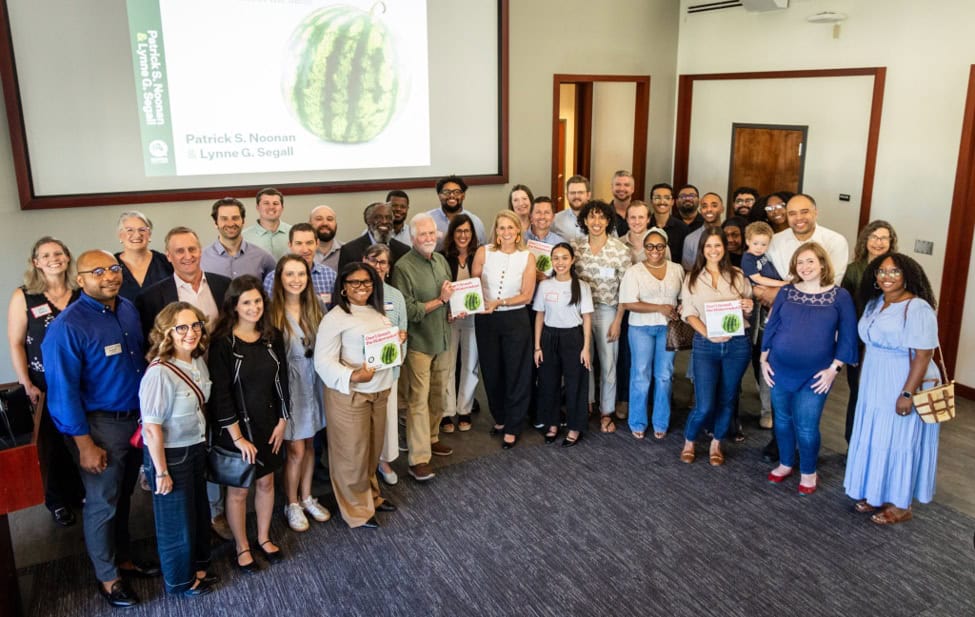
A new book from two longtime Goizueta collaborators offers a practical framework for solving complex business problems—without smashing the watermelon.
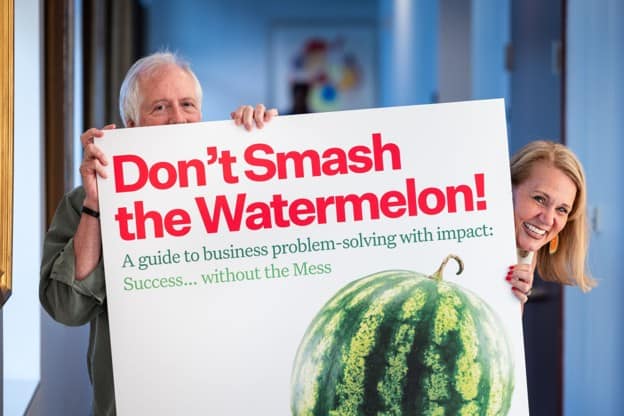
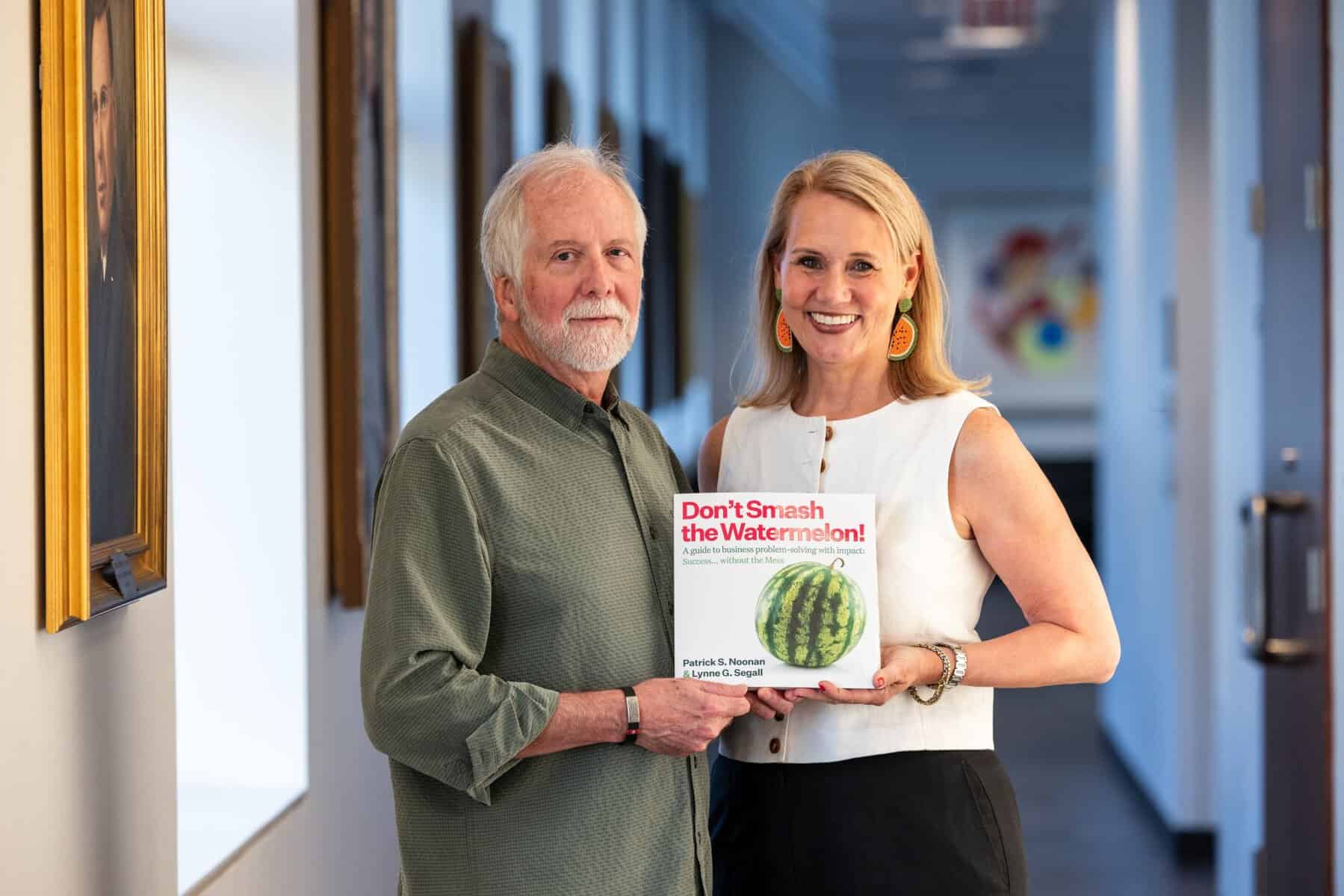
For more than three decades, Goizueta Business School educators Lynne G. Segall 99MBA, associate dean and associate professor in the practice of organization, and Patrick S. Noonan, professor emeritus in the practice of information systems and operations management, have collaborated in classrooms and beyond. Their work on experiential MBA teaching has culminated in a new book, Don’t Smash the Watermelon!
“In a way, the book’s origin dates to the 1999–2000 academic year, when we launched an experimental MBA course involving a field project for a very high-profile organization,” Noonan explains. Sports and entertainment executive Harvey Schiller (then a senior leader at Turner Sports, now chairman of Schiller Management Group) approached Goizueta with his desire to teach a project-based course for MBA students. “He had promised us a top-tier client to work with, but I was floored that he brought the New York Yankees,” recalls Noonan, who led the MBA programs at that time. “That organization was wrestling with whether to create an entertainment and sports network. It was a fantastic problem for our students: rich, challenging… and messy!”
After the initial presentation from the client, Noonan observed the students going around their meeting table rapid-fire, racing to divide and conquer. “As dean of the program, I wanted to be a fly on the wall to watch their process, and I’m sure glad I did!” The watermelon metaphor emerged suddenly as he imagined them smashing the problem, as if by throwing it roughly to the floor, grabbing the closest piece, and working independently on random elements of the problem. “Their approach would have left them with a chaotic mess. I started coaching them to do better than ‘smash-and-grab.’”
This “sticky” metaphor for team problem solving has guided Segall and Noonan’s teaching and writing, including the decade-long development of their book.
From Client Projects to a Problem-Solving Method
In that classroom, Noonan began thinking of the future. “As an institution, we expertly train people in business functions and methodologies. However, merely assigning projects – even with real clients and real problems – misses the additional capabilities that lead to professional success. Messy, unstructured problems require the ‘craft skills’ of working in teams, communicating and building relationships with problem owners, and thinking critically about the key questions and analyses,” Noonan says. “Top management consulting firms teach people to work this way, but I realized that every organization can benefit from these skills.”
Fast forward to 2008, when the Full-Time MBA curriculum was revised, creating the new course, Management Practice. Noonan points out, “We started addressing the missing glue and considered how management is actually practiced.”
“It wasn’t enough to just offer client experiences,” Segall says about this innovative MBA program enhancement. “Goizueta was determined to equip its students with a structured process, tools, and principles that would set them up for success no matter what industry or function they pursued after business school.”
The Goizueta Marketing Strategy Competition (GMSC), under the longtime leadership of Professor in the Practice of Marketing Reshma Shah, served as additional inspiration for classroom instruction on methodology and meaningful fieldwork, equipping students with specific tools to create more impact. “Students addressed real projects for real clients, with real money on the table, and they received instruction in the missing process skills,” Noonan says. “Our vision for Management Practice was that every MBA student should have that experience, regardless of function, level, industry or sector.”
“I had already begun to develop the material that evolved into this book,” he says. “When I retired, a national search led to Segall, who had run global professional development programs for Accenture’s strategy and management consulting practices focused on these same skills.”
Segall adds, “When Patrick had the idea to write a book together, I jumped at the chance to collaborate. We brought different skills and experiences to the project. Developing our material together and then testing it in the classroom has been a career highlight.”
Turning Classroom Lessons into a Book
Segall points out the “secret sauce” in Goizueta’s innovative curriculum: building the bridge from theory to practice. In 2018, Goizueta formally rebranded the Goizueta Marketing Strategy Competition and Management Practice client field studies as Goizueta IMPACT, which has become Goizueta’s signature approach to experiential learning. “We present real-world problems that integrate education and engagement. Students not only learn how to frame and break down problems; they learn how to synthesize their analysis, structure their arguments and deliver them in a way that gives stakeholders clarity and confidence to move forward,” she says. “Communication without integration of problem solving is just showmanship.”
In the leap from classroom to co-writing a bestselling book, Segall and Noonan spent a decade refining their vision. Meanwhile, students were getting a constantly updated guidebook of tools, laying out rough drafts of ideas that would end up in the final book.
While field testing the program content with every MBA cohort, the authors studied which concepts landed and where students struggled. Segall explains, “With each class, our teaching methods and nomenclature improved through insights gained from submissions and deliverables. What we found in our teaching is that metaphors and analogies are indeed sticky and give students a shorthand for understanding a concept.”
Segall shares, “It is working. We are so gratified that students returning from their internships tell us about being faced with complex problems, knowing exactly what to do, and having the confidence to take action.”
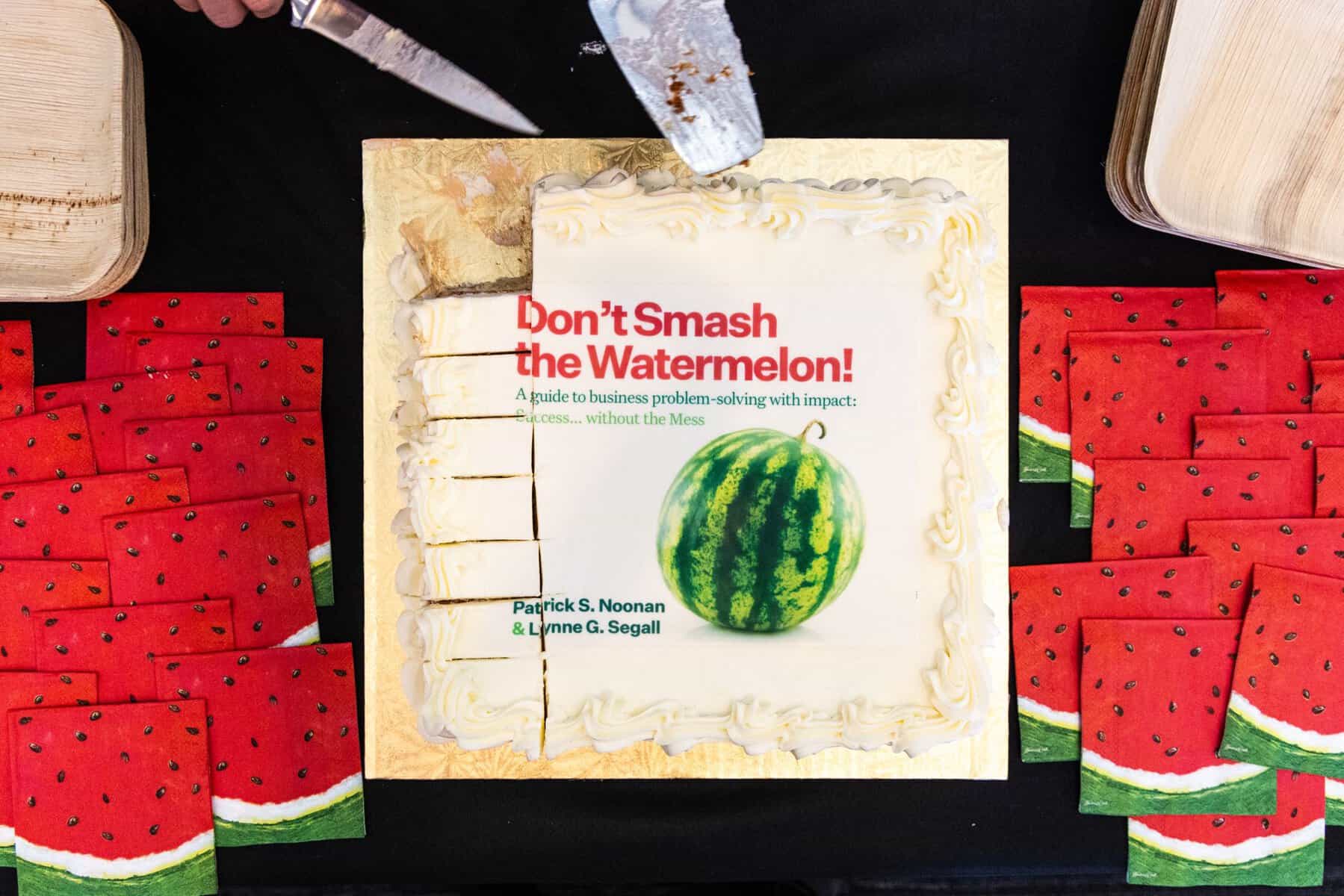
Noonan and Segall agree that “we’re most proud of the richness of examples we share. This book would not have existed without Goizueta having dabbled early in experiential learning. From the Yankees to Goizueta Marketing Strategy Competition to Management Practice to Goizueta IMPACT, we built a mechanism to provide MBA students with instruction and coaching, first in the classroom, then through fieldwork with projects. We created tools that helped Goizueta students perform well on their projects – and then take those skills to their interviews and their jobs.”
Noonan and Segall both recognize that Goizueta made an invaluable investment in experiential learning programming. Noonan concludes, “This approach sets our school apart nationally, and it is now a powerful part of the Goizueta experience.”
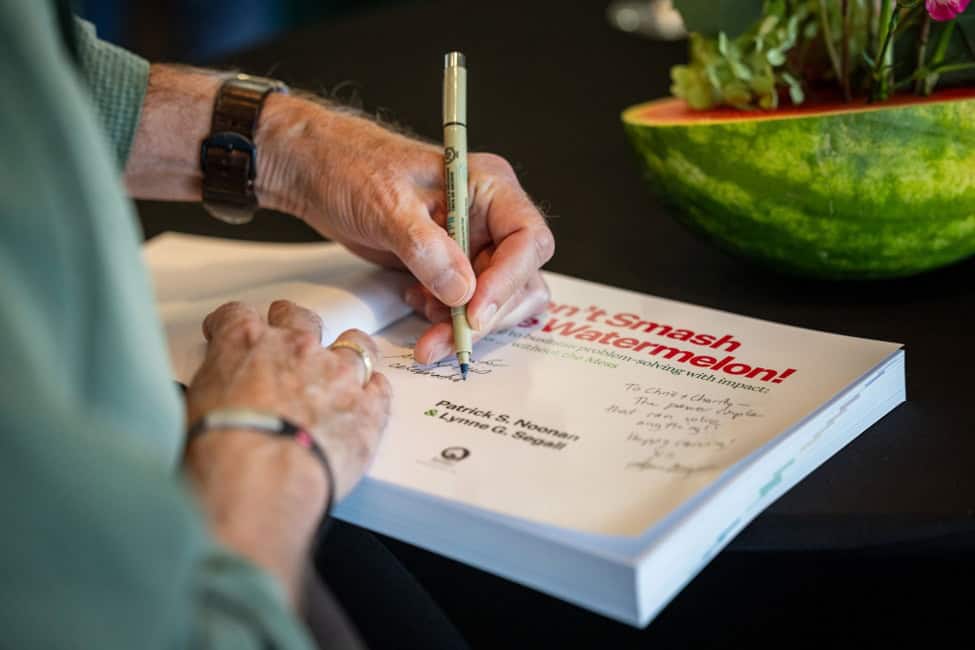
Want to learn more about the problem-solving approach behind the story? Explore Don’t Smash the Watermelon! by Patrick S. Noonan and Lynne G. Segall.
What Readers Are Saying About Don’t Smash the Watermelon!
“Don’t Smash the Watermelon! is essential reading for anyone navigating complexity, sharpening critical thinking, and applying structured problem-solving in an increasingly ambiguous world. It reflects much of the philosophy that underpins problem solving here at Delta: Define the problem clearly, structure the work deliberately, and then ensure that the insights translate into tangible action in a clear and concise manner. At its core, the book reframes problem-solving as a deeply human endeavor: one grounded in understanding how issues emerge, collaborating with stakeholders, and delivering evidence-based, actionable recommendations. Congratulations to Professors Noonan and Segall on developing something that so closely mirrors how we aspire to solve problems at Delta!”
— Alex Antilla 14MBA, Vice President, Latin America, Delta Air Lines
“This superb book is far more than a framework—it is a comprehensive and highly actionable playbook, introducing key principles and a clear process for successful problem-solving. But the authors don’t stop there: They delve into the dynamics of how high-performing teams should approach such challenges, and how to effectively engage critical stakeholders beyond the team. In doing so, they truly close the circle, offering a complete and holistic approach to problem-solving.”
— Percy Muente 08MBA, CEO, Agrícola Cerro Prieto
“In an increasingly unpredictable world, companies and executives need a structured approach to problem solving. Just like a wild river needs a bank to control its flow, many of today’s problems need a well thought out and structured approach to solving them. Patrick S. Noonan and Lynne G. Segall are masters at structured problem solving as evidenced in this work. They present bright, fresh, step-by-step solutions to age-old as well as more contemporary issues that corporations are facing on a daily basis. Both have excellent corporate and academic expertise in the area of business problem solutions.”
— Jag Sheth, Professor Emeritus, former Charles H. Kellstadt Professor of Business