
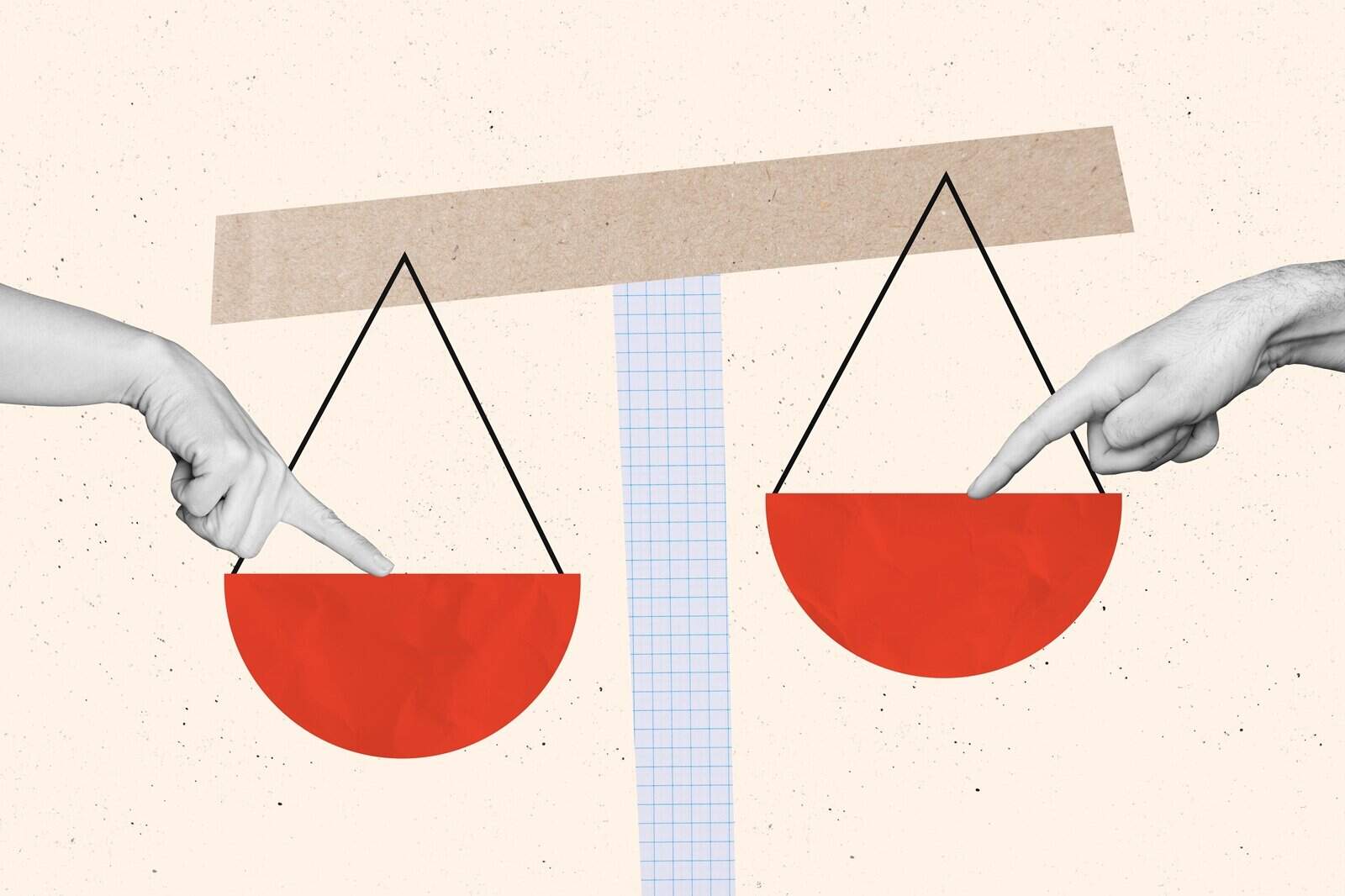
New research from Goizueta’s Laura Wallace explores how a strong preference for neutrality can discourage debate, suppress action, and shape how people respond to extreme information.
Considering the number of hot-button issues and divisiveness in American culture, choosing a middle-of-the-road attitude might be seen as the best way to navigate an often volatile environment. But what about those individuals who choose neutrality as a means of staying below the radar and, thereby, avoiding the need to take any action?
This is the question that Laura Wallace, assistant professor of organization and management at Emory’s Goizueta Business School, and coauthors ask in their new paper, The Preference for Attitude Neutrality. Published in the Journal of Experimental Psychology: General, the researchers explore individuals with a preference for neutrality and how their uncompromising commitment to neutral opinions, not only discourages rigorous debate but could have a deleterious impact on society.
Emory Business recently caught up with Wallace to discuss her research.
Emory Business: What sparked your interest in the preference for neutrality?
Wallace: When we think about the problems in the world, often people point to too many extreme opinions as the source of much social ill, and, of course, they can be. But, when I thought about a lot of the issues that I cared about, like addressing climate change or gun violence, I felt that sometimes the issue was too much neutrality in the face of issues that were themselves pretty extreme.
When I talk about this work, people can often picture someone who seems like a “Pref Neutral,” as we have affectionately nick-named them, that is someone who in the face of information suggesting that there is an extreme problem is not moved to address the issue. I could think of people in my life who had these reactions, and I was interested in understanding more about them.
Emory Business: How did you identify these individuals?
Wallace: We developed a scale to assess the extent to which people view neutrality as truer, more socially desirable, and more moral. For example, we ask people how much they agree with items like, “If you have all the facts about a topic, your opinion will generally end up somewhere neutral” and “There is something noble about remaining in the middle about controversial topics.” The more someone agrees with these items, the more we would say they have a preference for neutrality.
Emory Business: How does this study fit in with your larger body of work?
Wallace: I generally think of my program of research as studying the “psychology of social change.” Within that broad category, I study 1) how to change minds and build trust and 2) how to address societal disadvantage.
I view this work as fitting in the first bucket about how we change people’s minds. What interests me about people who are high in the preference for neutrality is the fact that they seem to NOT change their minds in the face of extreme information suggesting that they should. These individuals represent a significant barrier to our ability to address pressing issues, so I view this work as very much tied into the overarching goal of my research program to understand social change (or the lack thereof).
Emory Business: Would you describe a preference for neutrality to be a mindset, strategy, or attitude/value?
Wallace: I think of the preference for neutrality like an ideology or value system that guides people’s reactions across many issues and situations.
Emory Business: Talk about the study design. It’s quite detailed and multilayered, with eight hypotheses and six different measures to account for potential bias that were then randomized to create different questionnaires given to a large pool of individuals. How did the coauthors agree on the structure?
Wallace: First, I should take the opportunity to shout out Thomas Vaughan-Johnston, who led this work. He is a faculty member at Cardiff University and is just a very thoughtful, interesting researcher, and he’s great to work with.
Second, there are a number of studies in the paper. For each, our research team worked together to design and interpret the studies.
The paper paints a relatively negative view of Pref Neutrals. We did take measures to resist bias in our design. For instance, we didn’t just ask people how much they dislike extremists (which would have been biased towards making those with a preference for neutrality look bad), but also asked about attitudes towards neutrals (where those with a preference for neutrality may seem like “the nice people”).
We are now starting research on contexts where a preference for neutrality can offer some advantages, hopefully without artificially striking a false balance. For instance, we are considering whether they can help reduce group polarization effects, especially where groups drift towards radicalism in conversation. Also, we have some preliminary data where they seem to be a bit more accurate when detecting neutral emotions and attitudes in others, which is a remarkable plus side.
Basically, we think the preference for neutrality is a social concern, but we are trying to be fair-minded when considering why they think this about neutrality and when this trait is useful for the world.
Emory Business: In the study, you note that preference for neutrality can be a sign of arrogance and that Pref Neutrals are uninterested in learning more or changing their stance. How is this arrogance exhibited?
Wallace: I would say that they are more close-minded than arrogant and that they don’t seem to be particularly thoughtful. One way we have assessed this is by measuring their “intellectual humility,” which essentially captures how much people recognize the limits of their own perspectives and are open to changing their minds. Pref Neutrals tend to score low on intellectual humility. They also score a little low on the “need for cognition,” which captures how much people like to think.
Emory Business: In one section it reads: “preference for neutrality (preference for extremity) should relate to seeing other people as moral, competent, and likeable, when those individuals have generally neutral (extreme) opinions.”
Does this mean that they align with people who have their same opinion structure?
Wallace: We find that people who score high on the preference for neutrality scale tend to have more favorable impressions of others who are more neutral and tend to be more persuaded by others who are labeled as holding neutral attitude positions.
Emory Business: How would one identify this trait in a person, particularly, when the research shows they tend to self-censor?
Wallace: In general, they are really hesitant to take stances on issues or they tend to avoid taking sides or expressing strong positions. And yes, they tend to self-censor, meaning they often avoid sharing their opinion at all.
Emory Business: How does this preference for neutrality play out in a political sense? Specifically, if they are averse to extremes would they vote based on their values?
Wallace: We have a lot of evidence that Pref Neutrals tend to be political centrists. We don’t have evidence for this, but I suspect that they sit out a lot of elections, and to the extent that they do vote, they favor more moderate candidates. They probably would not vote for a position or individual with an extreme view unless it was framed as neutral. This may sound like a silly, cerebral point, but I actually think it’s critical to the point we are making, as what is viewed as “extreme” in a given time is often socially determined. For example, now it would be viewed as an extreme stance to support slavery. However, in the early 1800s in the U.S., it would have been viewed as an extreme stance to oppose slavery. I imagine at the time, many Pref Neutrals were supportive of slavery as a means of being politically moderate.
Emory Business: What was the most interesting result in this study for you?
Wallace: We find that if you give Pref Neutrals the exact same information but label it as extreme or neutral, they are more persuaded by the exact same information when it is labeled as neutral. This results in a kind of ironic effect where they actually end up with a more extreme opinion when information has been labeled as neutral.
Emory Business: Research wise, what’s next for you?
Wallace: There are a few ways that we are following up on our work that I am excited about:
First, we’re trying to understand more about how Pref Neutrals maintain neutral opinions in the face of extreme information. So, we are giving Pref Neutrals true, extreme facts, and then examining their thoughts to determine how they resist taking the extreme positions information would suggest that they should.
Second, we thought that Pref Neutrals would be particularly likely to trivialize social issues, to say they are unimportant. We are actually finding that they rate all social issues as extremely important, which we are trying to understand more about. We suspect they might do this as a strategy to avoid taking action on social issues. If stubbed toes and human trafficking are both “extremely” important, then there are just too many issues to take action on, and so they are able to justify a lack of action.
Third, we are interested in understanding what it is like to make decisions in a group with a Pref Neutral. There is a lot of evidence that groups tend to make bad decisions because people want to agree with each other. This might actually be an area where Pref Neutrals would shine – the fact that they don’t want to take a stance may force groups they are a part of to really think things through and make better decisions.
This is all super preliminary, but it reflects the exciting work ahead and that there is much more to understand about these folks!
From how opinions form and change to how leaders and organizations influence society, Goizueta faculty advance research that tackles complex, real-world challenges. Explore how their work drives impact beyond the classroom.