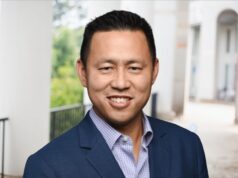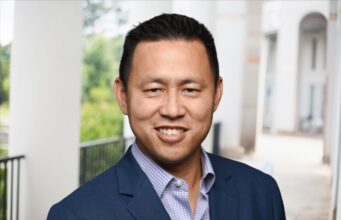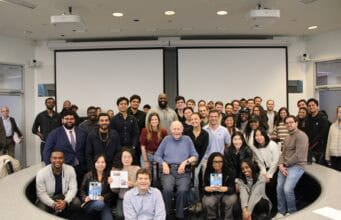

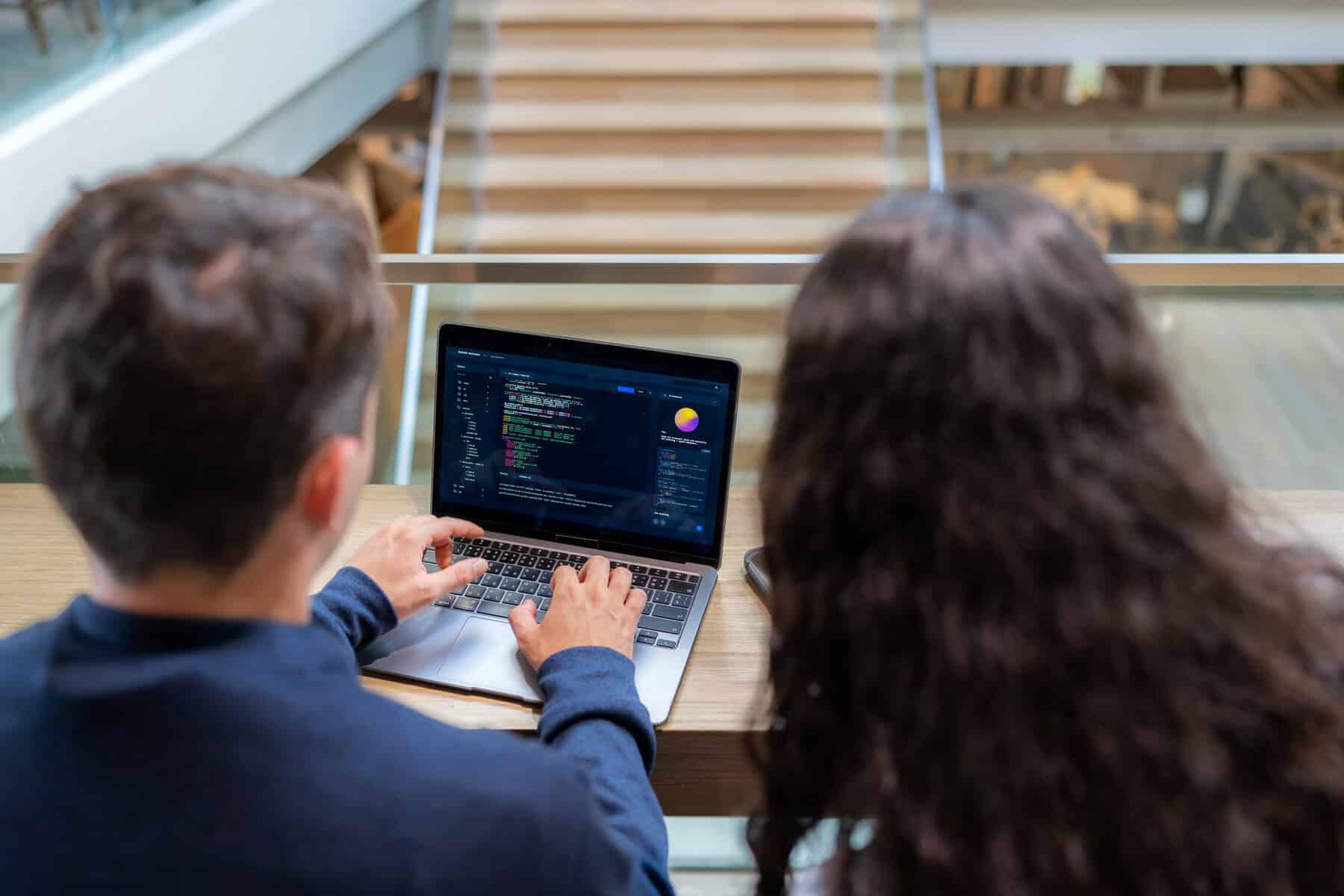
In a windowed classroom where laptops outnumber notebooks and whiteboards share space with dashboards, an MBA elective is quietly redefining what it means to be “business ready.” The course, Data Management, Analytics, and Artificial Intelligence, taught by Associate Professor of Information Systems & Operations Management Rajiv Garg, is less a traditional lecture and more like a working product lab.
Instead of memorizing frameworks about data-driven organizations, students build working solutions.
By the end of the semester, Full-time MBA students who entered with no technical background can ingest raw datasets, query databases using SQL, write Python scripts, and deploy functioning applications powered by generative AI. The goal is not to turn future executives into engineers; it is to make them literate in the language shaping every modern organization.
“The managers who succeed in the AI era will be those who can reimagine how work gets done. In this course, our students learn to see opportunities where others only see technology,” says Garg.
Learning by Building, Not Watching
The course is designed around a simple premise: today’s business professionals cannot lead digital transformation from PowerPoint slides alone.
Students learn technical tools—SQL, Python, Process Automation, Agentic AI—but only as instruments to solve real business problems across marketing, finance, healthcare, and sports. They ingest corporate and public datasets, clean them, analyze them, and present insights. Then they go further: they build products.
Generative AI is not treated as a novelty or a separate topic. It is embedded directly into workflow. Students use tools such as the ChatGPT or Claude code to generate and refine code, accelerating development while learning how to evaluate output critically.
“The future of work will be built on human–AI collaboration. Managers who succeed will be the ones who understand both the power and the limitations of AI, and who stay curious about how this partnership can help innovate solutions and enable quicker decisions,” explains Garg.
The structure deliberately removes barriers to entry. No prior analytics or programming experience is required—a reflection of how business education is evolving from specialization toward fluency.
From Assignments to Startups
By the second half of the course, the classroom resembles a product incubator. Teams choose an industry, identify a pain point, and build a functioning prototype.
The results are less hypothetical than many MBA capstones as evidenced by the projects executed.
CodeBlue IR—Healthcare Operations
Student team: Richard Kugblenu 26MBA, Kun Peng 26MBA, and Charlie Lindsey 26MBA
An AI-enabled clinical workflow assistant designed for emergency cardiac events. The system captures real-time Code Blue activity and automatically generates a smart and trackable notification process for healthcare professionals to follow so they can take their mind off of the process and focus on patients. Student team hoped to reduce the cognitive burden on heathcare professionals and increase health outcomes.
“Our project addressed the challenge of documenting Code Blue emergency events, where critical clinical interventions occur rapidly and documentation can easily become fragmented. We were surprised by how effectively a structured data capture system combined with AI-generated summaries could transform complex event logs into clear and actionable clinical documentation,” says Kun Peng 26MBA of Team CodeBlue.
Traider—Financial Market Intelligence
Student team: Jaime Alvarez 26MBA, Malcolm Henry 26MBA, and Hari Pilaka 26MBA
All individual investors have learned about machine learning and AI methods being used by investment firms. But these individual investors never had access to such resources. This student team saw an opportunity to empower investors with these cutting edge algorithms and created a trading analytics platform delivering machine-learning predictions, automated alerts, and real-time market insights using LSTM and XGBoost models combined with production-grade database architecture. The initial prototype lets investors trade in crypto markets and provide rich insights for the entire stock market.
Local Business Intelligence Assistant (LBIA)—Small Business Analytics
Student team: Marcia Rivera 26MBA, Alvaro Rojas 26MBA, Shiv Uppal 26MBA, and Simran Verma 26MBA
Every small business owner struggles to find data scientists that can help them understand their business data and provide guidance to make better decision. This student team developed a working prototype of a AI powered system that can easily do this and give the power of analytics and AI in the hands of small and medium sized business owners. They built a data operating system for small businesses with forecasting, KPI dashboards, anomaly detection, and AI-generated explanations.
When asked about why accessibility to analytics matters for smaller organizations, LBIA team member Shiv Uppal 26MBA says, “Small businesses generate valuable data every day but often lack the time or expertise to turn it into actionable insights. An AI-powered dashboard can surface key signals like inventory levels and best- or worst-selling products, helping owners make faster, smarter decisions without needing a dedicated analytics team.”
Thiroros—Hospitality Concierge AI
Student team: Alexandros Goulakos 26MBA, Pablo Hoyos 26MBA, Andres Ruiz 26MBA, and Richard Ryu 26MBA
To have the perfect vacation, you need a perfect concierge that understand you, your preferences, your budget, and the value of your time. Thiroros is an innovative app that provides an AI concierge that secures reservations, predicts availability, and curates recommendations using structured datasets and a natural-language booking agent. Travelers have flexibility to change at the last minute, and get rides to and from the locations with on time notifications. Its like traveling with your personal concierge!
“Hospitality still runs on fragmented booking systems and insider knowledge. We explored how an AI concierge could aggregate that information and translate personal preferences into real-time recommendations and reservations, creating a much more seamless customer experience,” says Thiroros team member, Alexandros Goulakos 26MBA, on how customer experience changes when AI becomes proactive instead of reactive.
Teaching Judgment in an Automated World
The course’s most distinctive feature may be what it does not promise. Students are not trained to rely on AI—they are trained to question it.
They prompt AI systems to generate code, then test and audit the results. They examine bias in outputs. They decide when automation helps and when human judgment matters more.
In other words, the technical skills serve a leadership outcome: decision quality.
“Understanding AI is no longer just for engineers. Just as managers once had to learn finance and data, tomorrow’s leaders must develop AI literacy to make better strategic decisions,” says Garg.
The MBA as a Future Operating System
Business education has long taught students how organizations function. Courses like this assume graduates will help design how they function next.
The shift reflects a broader change in executive responsibility. Leaders are no longer only consumers of reports; they shape the data infrastructure that produces them. They do not simply approve AI initiatives; they must understand how those systems reason, fail, and improve.
In this classroom, strategy discussions happen alongside database queries and model tuning—not because MBAs are becoming engineers, but because modern leadership requires fluency across both domains.
By semester’s end, students leave with more than a line on a résumé. They leave having built a system, deployed intelligence into a workflow, and confronted the ambiguity of machine-assisted decision-making.
The lesson is subtle but clear: the MBA of the future is not just about interpreting the digital economy—it is about operating inside it.
Goizueta’s Full-Time MBA equips students to turn passion into purpose-driven ventures. Learn more about the Two-Year MBA program.