

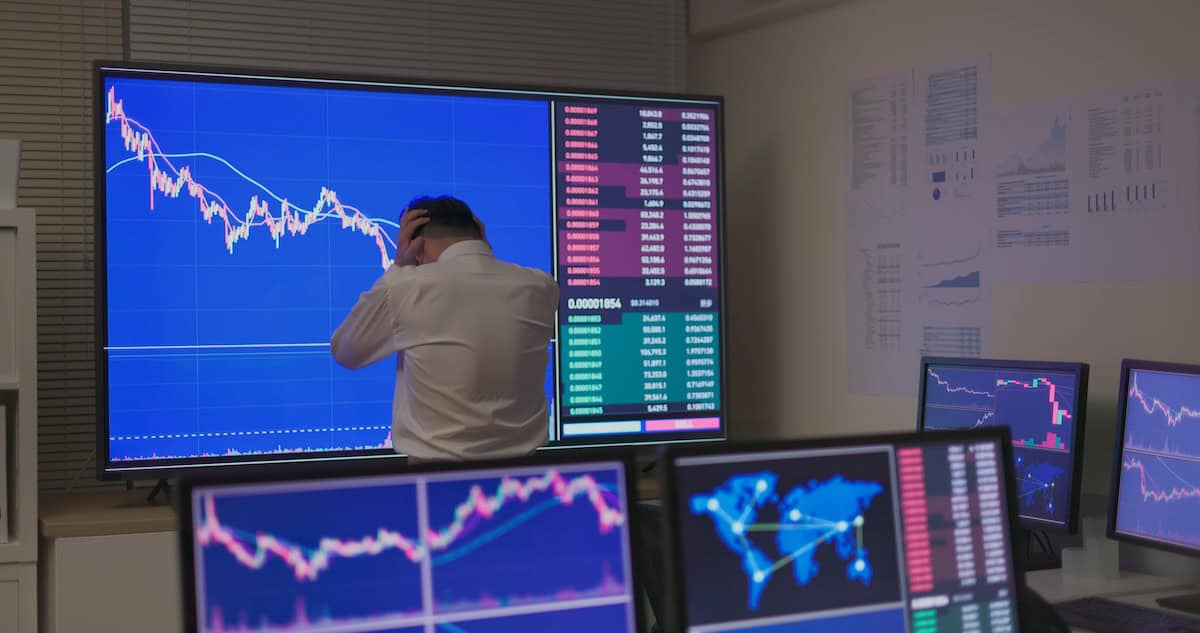
With retail investing—and buying frenzies predicted to soar—companies would do well to exercise extreme caution should they see their own stock prices suddenly soar, says T. Clifton Green, Goizueta Business School’s John W. McIntyre Professor of Finance. Check that impulse to raise capital for new investments, and don’t believe any hype about your firm that isn’t borne out by the fundamentals.
Back in 2022, AMC Theatres made headlines with news of an unusual acquisition. The cinema giant was to acquire a 22 percent stake in gold mining company, Hycroft Mining Holding Corporation: a cash deal worth $27.9 million which included a 71,000-acre mine in northern Nevada. The announcement raised more than a few eyebrows on Wall Street. While AMC management characterized the investment as “creating value by thinking outside the box,” analysts weren’t so sure; some describing the move as “embarrassingly stupid.”
The purchase of a gold mine in rural Nevada was the latest plot twist in a saga that had seen AMC teetering on the verge of bankruptcy just months earlier. With most of its cinemas shuttered due to the Covid-19 pandemic, the firm nonetheless saw its stock price soar a staggering 3,000 percent between January and June of 2021. The beneficiary of a flurry of retail investors—individual amateur investors using social media and private investing platforms to gather intelligence, and buy and sell stocks—AMC saw its shares hit highs in excess of $72 by late June. So intense was the buying frenzy in AMC stock that it not only took AMC back from the brink but enabled it to amass a $500 million “war chest” through the sale of shares: a fortune to deploy as management saw fit. Suddenly flush with cash, AMC duly went on something of a buying frenzy of its own—the purchase of Hycroft Mining described by CEO Adam Aron as “playing on the offense again with a bold diversification move.”
When Hype Drives Markets
AMC isn’t the first firm to cash in on “meme” stock trading—sudden volatility or surges in stock price and popularity primarily driven by online retail investor sentiment and social media hype, rather than standard financial fundamentals like revenue, assets, liabilities, and profitability. GameStop, a video game retailer, became the subject of a movie when retail investors on Reddit organized to buy shares and options, pushing its stock up by over 1700 percent and creating havoc for major hedge funds who’d been betting against it. At its peak, GameStop stock was trading at more than $480 per share.

And if AMC isn’t the first meme stock to hit the headlines, it’s also unlikely to be the last. As retail trading gains traction, accounting for more than 20 percent of Wall Street activity in 2025, there is every possibility that buying frenzies will becomes something of the norm rather than the exception. But what does it mean for firms that suddenly find themselves at the center of a trading fever, their stock prices skyrocketing? Should they, like AMC, start issuing new stocks at full tilt? And if so, what should they do with the cash?
The best strategy here is to exercise “extreme caution,” says T. Clifton Green, John W. McIntyre Professor of Finance at Goizueta.
Managers need to be careful not to read too much into a sudden surge in their stock price.
T. Clifton Green, John W. McIntyre Professor of Finance
Together with Russell Jame of the University of Kentucky, he has looked at more than a decade’s worth of trading and company data in the United States to glean some sense of what happens in the longer term when firms become the focus of buying frenzies: how they respond and the future impact of decisions they take during this period. What they find is that frenzies distort prices, prompting most firms to go ahead and issue more shares to raise capital. But where savvy firms use this capital judiciously—to pay off debt or make small, strategic investments—others take poorly-calculated risks, over-extending themselves by investing in mergers or acquisitions that perform badly in the longer run.

“Managers need to be careful not to read too much into a sudden surge in their stock price. Some firms respond by issuing equity and increasing investment, and in our data the ones that do worst tend to be the ones that invest the most,” says Green. “More generally, the increase in investment is concentrated among financially constrained firms led by lower-ability managers, and those are also the firms where the subsequent underperformance is most pronounced.”
Separating Hype from Fundamentals
Green and Jame look at 16 years’ worth of trade-level data from U.S. exchanges to identify periods of unusually strong retail buying. They classify a stock as experiencing a frenzy when net retail buying over a three-month window exceeds a threshold relative to shares outstanding. These episodes are associated with sharp price increases, about 20 percent on average during the frenzy period, followed by reversals over the next two years.
“We want to separate buying frenzies from just ‘good news’ about a company, and we do that by looking at what happens over time. If prices go up because someone’s performing well, they will remain high as the company continues to put out strong performance fundamentals. But with frenzies you see extreme volatility. Individuals are piling on to move prices, but then gradually start pulling out,” says Green. “We also look at things like how often different firms are mentioned on platforms like Reddit’s WallStreetBets and Seeking Alpha, since those tend to be associated with these episodes of retail buying.”
We want to separate buying frenzies from just ‘good news’ about a company.
T. Clifton Green
From there, he and Jame use firm-level financial statements, reports and news to determine which firms will announce mergers and acquisitions in the wake of extreme price run ups. They also integrate stock market data with data from the Institutional Broker’s Estimate System which tracks analysts’ forecasts of company earnings to see how companies were performing pre-frenzy, and how they fare afterwards. In total, they look at around 1,224 firms that have experienced at least one retail frenzy.
When Managers Believe Their Own Hype
“What we see is that the firms or managers that invest a lot are also those that haven’t been performing so well in the past. These ‘bad’ managers are the ones that are fooled by the frenzy into thinking they are more adept than they actually are,” says Green. “What happens afterwards is that they lose the benefits. If their stock price suddenly goes up by 30 percent, they end up killing all that advantage by issuing equity and making investments that don’t pay off.”
Don’t mistake hype for information.
T. Clifton Green
In 2025, AMC sold the majority of its stake in Hycroft Mining Holding Corporation for around $24 million, about $3 million less than it paid. From highs of $72, shares in the company have been trading in the region of $4 and $0.90 in the first half of 2026.
A Cautionary Tale for Firms
Meanwhile, signs are that retail investment and meme stock trading may be only set to intensify.
Fortune reports that almost $5.5 trillion in trading activity across stocks and exchange-traded funds was made by retail investors in 2025, an almost 47 percent increase from 2024, while WallStreetBets founder Jaime Rogozinski is confident that “meme stocks are about to leap-frog in size and scope and scale.” With the rise of zero-commission trading platforms such as Robin Hood or e-Toro and fractional trading that allows amateur investors to buy shares of a share, the barriers to individuals looking to move prices are becoming negligible. All that retail investors need is an iPhone and an app, says Green. The option to trade is immediate and for as much or as little as each individual decides.
In this climate, firms would do well to view AMC’s fate as a cautionary tale, he warns, and view any sudden surge in their own share prices with healthy cynicism.
Exercise extreme caution because your stock price might plummet just as quickly as it’s risen.
T. Clifton Green
“We have a history of managers looking at stock prices as a measure of performance and prospects. But our evidence suggests that you need to know why your stock price has suddenly shot up by 25 percent. Don’t mistake hype for information.”
None of this is to say that firms should not take advantage of elevated valuations, he adds. Issuing equity during a frenzy can be a fast track to raising capital on favorable terms. The key is to use the proceeds conservatively. Firms that pay down debt tend to fare better going forward than those that rush into ambitious expansion or unrelated acquisitions; mistakes that become apparent once the frenzy abates and valuations level back out.
“If you want to issue equity, be advised that it’s probably not a good time to invest,” says Green. “Above all, exercise extreme caution because your stock price might plummet just as quickly as it’s risen.”
From investor behavior and market dynamics to corporate strategy and decision-making, Goizueta faculty research generates insights with real-world impact. Explore more faculty insights and innovations.