

New research from Mike Lewis explores how the NFL became one of America’s most powerful cultural connectors—and what its success can teach us about building fandom.
The United States feels pretty partisan right now. Data from Pew Research Center and elsewhere points to serious ideological, social, and economic divisions—fault lines carving the country into rival camps both in politics and in daily life. Americans seem to disagree on a lot. From the economy to immigration, from free speech to the sources of information and news that we consume and the online communities that we inhabit, it feels like we just can’t get on the same page.
Some of this may be the result of a more diverse society, says Mike Lewis, professor of marketing at Goizueta Business School. As the U.S. has become more culturally and racially heterogeneous, there are naturally fewer shared experiences or references connecting people than before. At the same time, we are witnessing the systematic erosion of local media and community structures—the connective tissue that gives people a common sense of place, identity, and belonging.
The United States increasingly feels like a country of disparate views, tastes, opinions and passions. Yet there is one thing that is still capable of uniting its population, says Lewis. There is one cultural phenomenon that more than half of all Americans care about and remain invested in—and that’s football. Specifically, it is the National Football League (NFL).
The NFL: America’s Connective Cultural Tissue
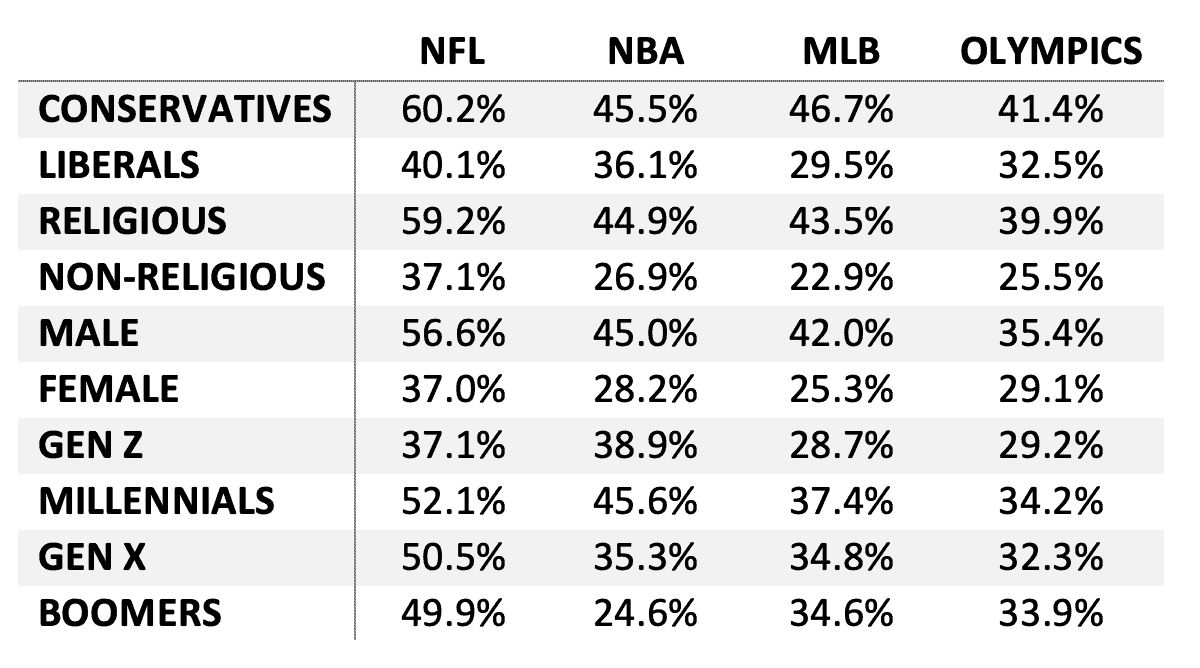
Lewis investigates the most critical trends in sports, entertainment, and political fandom in the States today. Data from his annual fandom survey in 2026 reveals that among other sports, the NFL enjoys a singular and commanding position in popularity and fandom; significantly ahead of the National Basketball Association, Major League Baseball, or the Olympics. The survey finds that 46.7 percent of Americans identify as “at least casual fans” of the league, giving it a 10-point lead over rival major sports institutions, and eclipsing other major cultural institutions and phenomena in the U.S. today.
The cultural conversation in the United States today is whether Mahomes will surpass Brady, the battle for the West Coast—whether the 49ers are back—the next quarterback cohort and how Mendoza will perform, according to Lewis. The Super Bowl has become an unofficial U.S. holiday—the most-viewed sporting event, the most-viewed musical event and the day of most gambling and (second) most eating nationwide, he adds.
“The NFL is arguably the biggest thing that unites Americans today,” says Lewis. “And it unites us across diverse demographics.”
While Lewis’ data suggests that overall NFL fandom skews slightly male and older—and that among Black Americans, the NBA narrowly surpasses it in popularity—the NFL remains the absolute leading sporting and cultural connector across political, social, racial, and generational lines. It is the number one league for both conservatives and liberals, for the faithful and non-religious, men and women, across income and education, he says. “We are a politicized nation—characterized right now by fragmentation, by polarization, by people pitting themselves against other people, ideologically, politically, socially, racially, and along a whole different group of fault lines, and yet, looking at this survey data, you see that difference doesn’t matter. You can’t guess who a typical NFL club supporter or fan will be.”
“If you went into the local church and did a poll, the NFL would be the favorite sport. Same in a ladies’ mahjong club or a gay bar. It seems like the NFL has a centrality—a connective tissue—that transcends a lot of fragmentation.”
Mike Lewis, Professor of Marketing
Fandom identity appears to have it over ideology, says Lewis.
So what is it that makes the NFL so popular? Partly, it’s history, says Lewis.
From Sport to Cultural Institution
Football has long enjoyed a privileged place in American tradition. Friday nights are for high-school football, Saturdays for college games, and Sundays are for the NFL. Since it kicked off in the 1920s, professional football has become deeply embedded in American life. The weekly game that brought the family together around a single television set has become as baked into custom and culture as going to church and eating Sunday dinner, says Lewis.
Meanwhile, where baseball has historically seen more than 160 games played in a season, NFL matches were limited first to 12, then 16, and now 17, making them more of a “spectacle” in comparison, he says. And it is this sense of event and cultural ritual—something scarce, highly anticipated, and consequential—that has cemented the NFL’s place as an American institution.
“The NFL gives you ritual and spectacle, from the communal structure of watching together on Sunday, to the NFL films that replay historic moments and set them to stirring Wagnerian scores, through to the Super Bowl with all of its pomp and ceremony. There’s something dramatic and eventful, and a kind of storytelling around the NFL that makes it not only great for TV—and therefore broader consumption—but also easy to archive, to monumentalize. Stories of heroes, rivalries, triumphs, and disasters that accumulate meaning around the product generation after generation.”
The Super Bowl has become the fullest expression of this transformation, says Lewis. Simultaneously a sporting contest, high-octane show business event, advertising mega-opportunity, gambling phenomenon, social and commercial spectacle, it has become more of a cultural holiday than a simple championship game—and of a magnitude that eclipses America’s other major sports. The comparison does not end there, he adds.
Baseball retains a strong connection to place and family as a shared experience—though its 162-game season and local focus give it a different cultural identity. The NBA, meanwhile, has developed a cultural power through the individual personalities of its players. Its stars have become national cultural figures, while the League itself is increasingly intertwined with pop culture and the media.
The NFL, says Lewis, does both.
NFL teams have strong local identities, but the League operates at a national scale—with plans to expand internationally. It has its stars, but the institution is bigger than any individual player. It has competition, entertainment, and storytelling, but it also has rituals that are repeated across generations, giving it a kind of institutional continuity that makes fandom transferable across generations. Lewis describes the NFL as “essentially immortal.”
“There is a continuity reinforced by rituals and shared experiences that have become locked into American culture from Sunday games and family viewing to the almighty Super Bowl. The result can be seen as the last thing connecting Americans today—a cultural touchpoint that can still bring people together across some of the fault lines of our increasingly fragmented society.”
What the NFL Teaches Us About Fandom
If the NFL has built a fandom that transcends difference, what insights are there for other institutions and organizations looking to do the same—to build something important enough that all kinds of people want to belong to it?
The answer, says Lewis, lies in meaning: in cultural meaning that is real, that is authentic and above all, earned.
The NFL’s power as a brand is undergirded by legitimacy: real competition between elite athletes, consequential outcomes, exceptional performances, and a consolidated history of shared cultural experiences. Its marketing efforts underscore and reinforce these qualities; they do not create or simulate them.
For organizations looking to build fandom of their own, this can be distilled into four key principles, says Lewis.
- Excellence precedes fandom. Real attachment stems from excellence, be that exceptional and sustained sporting performance, intellectual distinction, or unmistakable quality. Marketing can amplify excellence, but it cannot compensate for its absence.
- Authenticity cannot be manufactured. The vernacular of authenticity has become ubiquitous in marketing. But just calling something authentic doesn’t automatically make it so. In the NFL, competition is real, outcomes are real—and so is the emotional investment of fans. Organizations should pinpoint what is genuinely distinctive or unique about their brand, and build around that.
- Fandom is tied to aspiration. Fandom is an act of association: people want to associate themselves with something they value, prize, or aspire to in terms of excellence, achievement, identity, or community. More than a functional product or service, brands should seek to create something authentic that people want to belong to.
- Fandom takes time. The NFL as a cultural institution didn’t happen overnight. Like Coca-Cola, the NFL has taken decades to build and sustain associations, shared experiences, and earned, authentic cultural meaning. This is contingent on consistency over time—repeated encounters, continuous excellence, and fan experience passed from one generation to the next.
The NFL has cemented its position as a touchstone within an increasingly fragmented U.S. Can it make Americans agree? Not really. Nor can it bridge every divide. Yet it can do something unique, and that is to provide a reason and a space for people to occupy the same cultural space. We may disagree over which team should win. But for a few hours on a Sunday, we are still watching the same game.