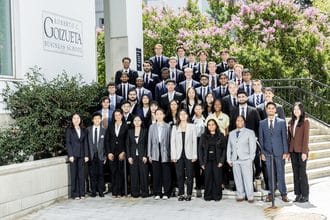

Master of Science in Business Analytics students put their skills to the test, developing practical solutions to a real-world healthcare business problem.
For organizations making complex business decisions, finding the right solution takes more than analyzing numbers. It requires understanding the problem, weighing competing priorities, and developing recommendations that can work in practice.
That was the challenge facing students in Goizueta Business School’s Master of Science in Business Analytics program this fall as they partnered with Emory Healthcare for the 2026 Business Analytics Challenge.
Working in teams, students were tasked with identifying ways Emory Healthcare could optimize its supplier payment methods to generate greater financial value. The assignment required them to consider not only potential financial benefits but also supplier relationships, operational constraints, and the feasibility of putting their recommendations into action.
A Real-World Problem with Real-World Constraints
The challenge centered on Emory Healthcare’s procure-to-pay process, which encompasses purchasing goods and services and ensuring suppliers are paid accurately and on time.
With a large network of suppliers and multiple payment methods available, Emory Healthcare wanted students to explore how the organization could make more strategic payment decisions while developing a framework that could guide those decisions in the future.
“Given the close relationship between Emory University and Emory Healthcare, partnering with Goizueta’s MS in Business Analytics students felt like a natural fit,” says Casey Hogan, manager of supply chain transformation at Emory Healthcare. “Students are continually learning analytical methods and theoretical approaches that our operational teams may not have the time to explore in their day-to-day work. This was an opportunity to connect that learning with a practical business need.”
What made the challenge especially valuable was that it mirrored the type of ambiguity analytics professionals face in the real world. Students were not given a neatly defined analytics problem. Instead, they had to understand the business context, identify where value might exist, determine what data would be needed, and translate a complex operational challenge into a well-scoped analytics opportunity.
Scott Radcliffe, Managing Director, MS in Business Analytics
The competition brought students together with Emory Healthcare supply chain professionals who introduced the challenge, answered questions, and evaluated the final presentations.
For Scott Radcliffe, managing director of Goizueta’s Master of Science in Business Analytics program, the challenge offered students an opportunity to develop skills that are difficult to replicate in a traditional classroom setting.
“What made the challenge especially valuable was that it mirrored the type of ambiguity analytics professionals face in the real world,” Radcliffe says. “Students were not given a neatly defined analytics problem. Instead, they had to understand the business context, identify where value might exist, determine what data would be needed, and translate a complex operational challenge into a well-scoped analytics opportunity.”
Finding Solutions That Work Beyond the Classroom
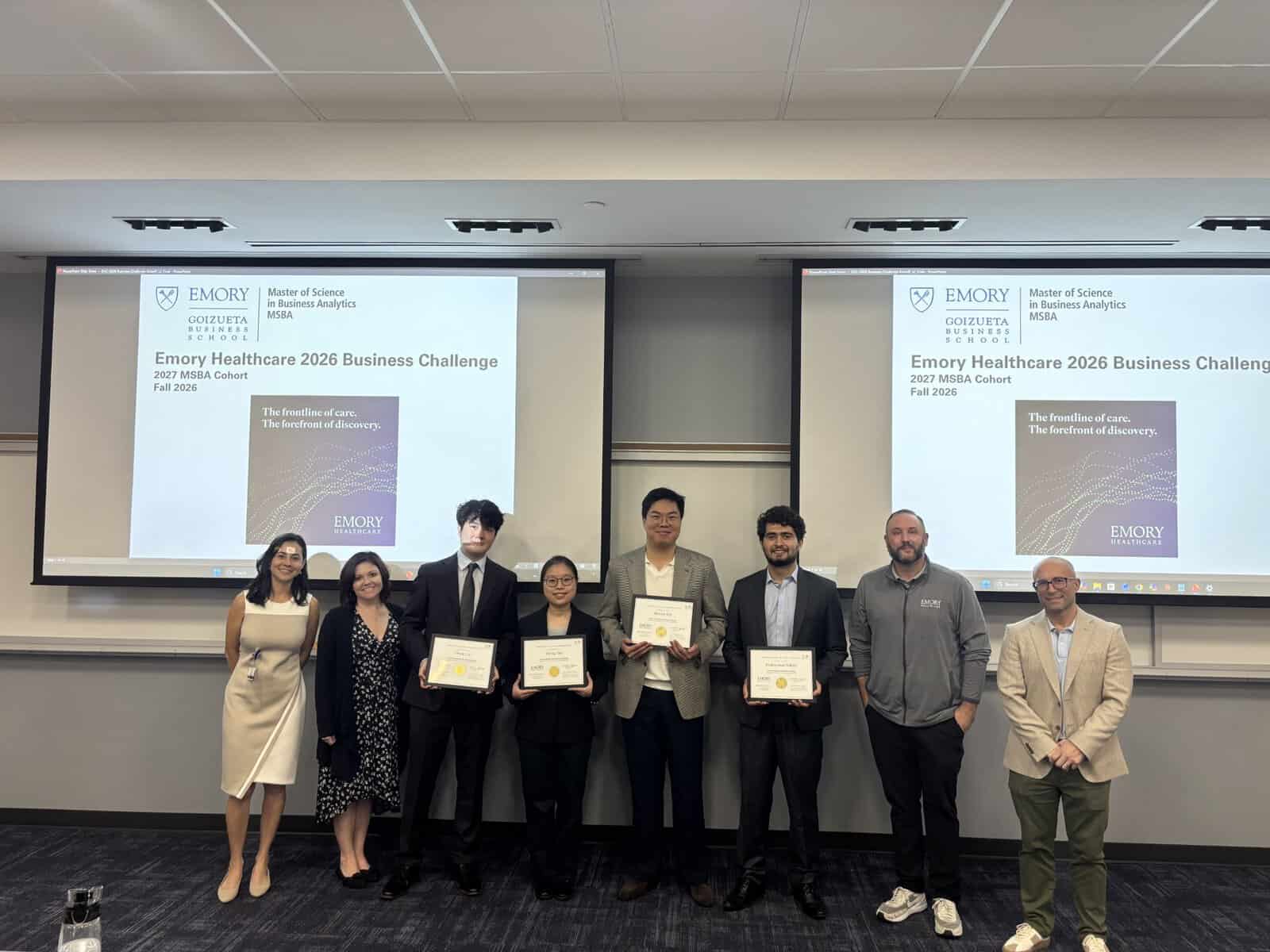
Three teams advanced to the final round of the competition, held in September. Team Data Vitals, comprising Derek Liu 27MSBA, Muhammad Suhail 27MSBA, Bowen Wei 27MSBA, and Yining Yan 27MSBA, took first place, followed by M&M in second and The Fantastic Four in third.
For the winning team, one of the biggest lessons was that the most financially attractive option wasn’t necessarily the most practical.
“The most challenging part was realizing that the best solution on paper isn’t always the best solution in practice,” says Yining Yan. “It pushed us to think beyond what the data tells us and focus on what an organization can actually implement.”
The team developed a framework to evaluate payment options based on both potential financial returns and the likelihood that suppliers would accept them. An interactive dashboard allowed users to adjust assumptions and see how those changes affected the recommendations.
The most challenging part was realizing that the best solution on paper isn’t always the best solution in practice. It pushed us to think beyond what the data tells us and focus on what an organization can actually implement.
Yining Yan 27MSBA
For Muhammad Suhail, the experience reinforced the importance of designing solutions that organizations can actually use.
“I learned that a recommendation is only as good as its adoption,” he says.
Suhail helped develop a proposed implementation approach that included a 90-day pilot and an ongoing process for reviewing payment decisions. Rather than treating the analysis as an endpoint, the team considered how Emory Healthcare employees might incorporate the recommendations into their regular operations.
Bowen Wei came away with a related insight: More sophisticated analytics aren’t always better analytics.
“The simplicity of our model helped us win the first place,” Wei says.
The experience reinforced a lesson he had encountered in his coursework: A model that performs well technically may not be the best choice if it is too complicated for an organization to implement.
Preparing Students for What’s Next
The Business Analytics Challenge is designed to help students develop skills that extend beyond technical analysis, including defining business problems, engaging stakeholders, and communicating recommendations to decision-makers.
It also helps prepare students for the program’s spring practicum, when they work with sponsoring organizations on real-world analytics projects.
“The challenge allows students to practice stakeholder engagement, business discovery, project scoping, and executive communication before entering those larger engagements,” Radcliffe says.
He adds that the experience encourages students to think beyond the technical aspects of analytics and consider how their recommendations will work within an organization.
“The strongest teams moved beyond simply identifying analytical opportunities and focused on implementation, stakeholder adoption, operational feasibility, and change management,” Radcliffe says. “They recognized that successful analytics initiatives are as much about people and processes as they are about data and models.”
Students are continually learning analytical methods and theoretical approaches that our operational teams may not have the time to explore in their day-to-day work. This was an opportunity to connect that learning with a practical business need.
Casey Hogan, Manager of Supply Chain Transformation, Emory Healthcare
For Emory Healthcare, the value of the collaboration extended beyond the competition itself.
“We particularly valued the fresh, unbiased perspective the students brought,” Hogan says. “When you work within a process every day, you can become accustomed to how things are done. Students come in without that same history and ask questions that prompt us to reconsider things we might otherwise take for granted.”
Hogan also appreciated the students’ attention to implementation, including their recommendations for testing ideas through pilots and defined timelines.
The partnership illustrates how experiential learning can benefit both students and the organizations they work with. Students gain experience navigating complex business challenges, while partners gain new perspectives on problems that affect their operations.
“Good analysis needs to help people make decisions, and the students demonstrated the importance of communicating both what they found and what we could do with it,” Hogan says.
Learn more about Goizueta’s Master of Science in Business Analytics program and how students apply analytical skills to real-world business challenges.