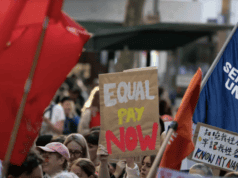


The gender wage gap shows no sign of improving any time soon. If anything, evidence suggests it’s growing in the United States.
Recent stats show that for every dollar earned by men, women in the same job earn just 92 cents—that equates to one month of salary less in a given year. That gap widens even more for Black and other minority women. In the meantime, men’s wages are increasing—just shy of 4% in the last two years—while women’s income hasn’t budged.
Organizations should take note, warn Goizueta’s Karl Schuhmacher and Kristy Towry. Wage inequity is an issue that undermines the concept of equal pay for equal work. It’s also bad for business. Employers that don’t pay or play fair with their workers stand to lose talent to competitors who offer better conditions, not to mention customers or investors who care about fairness. And that’s not all. In meritocracies, employees are incentivized to engage more, care more, and create more value because they understand their compensation is pegged to the effort they make and outcomes they achieve—to merit itself, regardless of demographics.
The gender wage gap in the United States is inherently unmeritocratic. And fixing it has proved elusive—at least until now. In their new study, co-authored by Goizueta PhD graduate, Hayden T. Gunnell 25PhD of the University of Texas in Austin, Schuhmacher and Towry have come up with a novel approach to addressing the gender wage gap; one as practicable as it is simple. And it’s all down to percentages.
Pay Gaps Baked In
Most employers review employee salaries on an annual basis—usually yoking them to performance reviews. Overwhelmingly, managers will frame raises in terms of percentages: those doing well might be awarded a five or even 10 percent pay raise, for example. The problem with this, argues Schuhmacher, is that percentage-based raises are tied to initial salaries. And if that baseline is biased from the start, handing out similar percentage raises will only compound the problem, and perpetuate inequities—whatever the intention.
If women start out getting paid less than men for the same job, and your raise budgets are framed in percentages, you end up baking those gaps in more, even if you don’t mean to.
Karl Schuhmacher, Assistant Professor of Accounting
“That five percent raise you’re giving everyone for the same job well done sounds fair and effective,” says Schuhmacher. “But it’s only actually fair if the initial salary is equitable—if Jane has been making the same as John from the off. And if she hasn’t—if John is being overcompensated relative to Jane—then all you’re doing is perpetuating that gap.”
Awarding similar percentage raises doesn’t recognize or acknowledge preexisting, unfair discrepancies in initial salaries. A better approach, he and Towry argue, is to reframe pay raise budgets in terms of absolute dollars.
“Budgeting for raises in absolute terms—a $150,000 pool for all raises in a group, say, versus a budgeted pool of 5% per person—automatically unshackles raises from preexisting unfairness in people’s pay,” says Schuhmacher. “You reduce the risk of perpetuating pay gaps by giving managers a way of assessing and evaluating work and assigning a dollar value that recognizes that work. It’s a fairer, more meritocratic approach.”
It also has the effect of “nudging the cognitive processes” that employers use. Percentages are a ubiquitous way of determining raise budgets because they feel fair and easy to use, says Towry. A five percent raise for employees sounds reasonable, equitable, and doesn’t tax managers cognitively, making it simple to implement again and again—a norm or procedural “anchor” within most organizations. Substituting dollars for percentages, however, should provide enough of a nudge that managers focus more on the actual value their employees contribute to the organization. And it shouldn’t require a major rehaul of the system: a win-win for employees and organizations looking to retain talent, says Towry, where the gains significantly outweigh the effort involved.
Thinking in Dollars, Not Percentages
To put this idea to the test, Towry, Schuhmacher, and Gunnell enlisted Goizueta MBA students to participate in a lab experiment, taking on the role of manager at a hypothetical bank. Participants were given the salary details of four high-performing employees—two male, two female—with gender discrepancies baked into initial pay. Importantly, in this setting, male and female employees do the same job and perform equally well. Participants were divided into two camps: the first instructed to hand out percentage raises, the second dollar raises. All participants had to allocate the same pay raise budget of $30,800—5% of total salaries—among the two male and two female employees, the sole difference being that one group received a percentage budget, while the other group received a dollar budget.
The results support the theory, says Towry.
When participants use percentages, the individual pay raises cluster around the 5% mark, meaning that existing pay gaps are perpetuated.
Kristy Towry, Professor Emerita of Accounting
“Our fictional male employees, Jason and Gary, walk away with higher overall raises than Martha and Sarah, because they are already earning more than the women,” says Towry. “And this happens even though our participants know about initial pay discrepancies, and women and men perform equally well in the same job.”
When participants use absolute dollars, however, this clustering effect around the 5% mark disappears. Participants give pay raises that better reflect employees’ value contributions to the organization. As such, pay raises are less dependent on initial pay gaps. In some cases, participants even award more cash to the women than the men to counteract the initial gap.
“Martha ends up with a higher raise than Gary, but their initial salaries are $116,000 and $192,000, respectively,” says Towry. “So, what we’re seeing here is that our managers are asked to take out the percentage and think in dollars, they effectively redress the balance. The preexisting pay gap is reduced in recognition of equal merit.”
Reproducing this in real-word settings shouldn’t be difficult for organizations. And at a time when gaps are becoming more entrenched and progress on equitable pay is stagnating in the United States, there is a clear imperative ahead of employers interested in sending clear signals to existing and future male and female talent, says Schuhmacher.
Pay that reflects performance fairly is inherently meritocratic and we know that being a meritocracy is attractive to employees—to your existing workforce and to the workforce that you want to attract.
Karl Schuhmacher
“When people know they’re being evaluated based on their results, regardless of their gender or background, they are more motivated to work hard,” says Schumacher.
“The beauty of this solution is that it supports a more meritocratic way of rewarding talent. It’s also easy to implement—easier than interventions like bias training or organizational audits that consume time and resources. Using dollars instead of percentages is something that organizations can do that translates into real impact. And it’s something that they can do in a day. Our advice: start tomorrow!”
From pay equity and leadership to innovation and decision-making, Goizueta faculty research explores the ideas shaping business and society. Explore more faculty research.