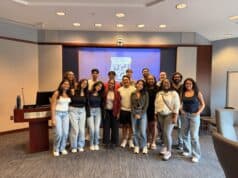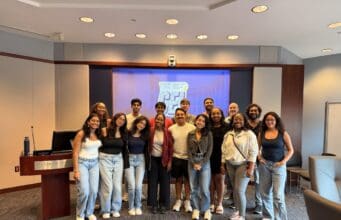


When Pranay Mamileti 26BBA formed the Peer Advocate Office, it was a manifestation of the values that have guided him throughout his time at Emory: caring for his fellow students, building bridges with administrators and developing practical solutions to enhance campus life.
The Peer Advocate Office serves as a digital hub for students with questions about life at Emory, covering everything from financial aid to academic advising. Student volunteers respond to emailed questions from other students by connecting them with the appropriate Emory resources to address their concerns.
Mamileti, a political science and business double major from California’s Bay Area, used his experiences answering calls from constituents for the office of Jon Ossoff, a U.S. Senator for Georgia, as a model for the student hub. He helped design a training program for student volunteers to learn about campus resources, and he worked with representatives from departments across the university to ensure the office he envisioned would meet legal compliance.
The Peer Advocate Office opened in 2024, during Mamileti’s term as vice president of the Emory Student Government Association (SGA).
After its launch, Mamileti was proud to personally handle the first request, helping a student find the right Emory contact for a question about campus housing bills. Working together, they solved the problem.
“That experience really warmed my heart, and it underscored why I wanted to create the office in the first place,” Mamileti says. “It can be really hard to know where to go unless you’re deeply involved with the system or know people who are.”
As Mamileti graduates, he leaves behind an established, thriving Peer Advocate Office, set up for continued success with a team of student volunteers from all class years.
But that’s not his only reason to celebrate.
At the 2026 Commencement ceremony, Mamileti will receive Emory’s highest undergraduate student honor: the Marion Luther Brittain Award, presented to the undergraduate who has performed the most significant, meritorious and devoted service to the university.
“I’m immensely grateful to everybody who has been behind me this whole time,” Mamileti says. “Everything that I’ve done at Emory is rooted in a firm belief in those around me, and in everyone’s goodness. I have always tried my best to take what I’m good at and apply it to make things a little better for everybody else.”
A Bold Leader
Mamileti’s impact on Emory campus life has been vast. In addition to his role as SGA vice president, he served as SGA speaker of the senate during his senior year. He was also a moderator for Wonderful Wednesday—the beloved Emory tradition that highlights different parts of the campus community each week.
Lydia Washington, executive director of student centers and student engagement for Emory Campus Life, works with the student moderators to program Wonderful Wednesday, where Mamileti led several initiatives, such as voter registration campaigns that added hundreds of students to Georgia voter rolls. But Washington was most impressed by his ability to listen and engage with students in need.
“I’ve seen students rely on him for a lot of things,” Washington says. “He’s able to navigate and talk to administrators, and he has been a good vessel for students who aren’t sure how to approach their problems on an institutional level. Students really respect him, because he makes himself available for that. He’s a bold leader.”
Mamileti says his experience in the classroom—and as an All-American attorney for Emory’s Ben Pius Mock Trial Team1—informed his approach to leadership.
“My marketing classes helped me learn and understand how what I say—and what SGA says—will be received and how that information trickles down,” he says. “It made me think carefully about how I was communicating.”
Paying it Forward
Foundational change has followed Mamileti every step of the way at Emory.
As co-chair of the Open Expression Student Committee, he led an effort to collect more than 800 student feedback forms on open expression. He then analyzed the more than 20,000 data points he collected and transformed them into recommendations that he presented to university leadership. Those recommendations influenced amendments to Emory’s open-expression policy.
Working with Emory’s Sexual Assault Peer Advocates, Mamileti restarted an intiative called SAFE Greeks that had been dormant for several years. He helped organize trauma-informed, empirically grounded sexual assault prevention training sessions for more than 400 student leaders in the campus Greek community.
“I’m deeply proud of his journey here at Emory,” Washington says. “He’s helped create community and belonging for so many students.”
She adds that she has seen Mamileti grow and be challenged—which are experiences Mamileti says are hallmarks of an Emory education.
“These past four years, I’ve had the privilege of testing my beliefs as strenuously as possible,” he says. “I’ve had to defend those beliefs to myself and sometimes question them. Now I know why I care about these things, and how much I care. Emory has uniquely given me the privilege of being in positions to struggle through those positions and figure that out.”
Through it all, Mamileti has relied on his family. He says his parents instilled in him the values that guided him across his many Emory endeavors.
“My parents have always said that I have a responsibility to pay it forward,” he explains. “My senior year, I’ve spent a lot of time thinking about who I am and who I want to be. I feel like I just care. I care that things are good, and that people are happy and able to succeed. And I care about my role in that.”
After graduation, Mamileti plans to work in politics and eventually go to law school, where he says he will continue to care—and continue to pay it forward.