

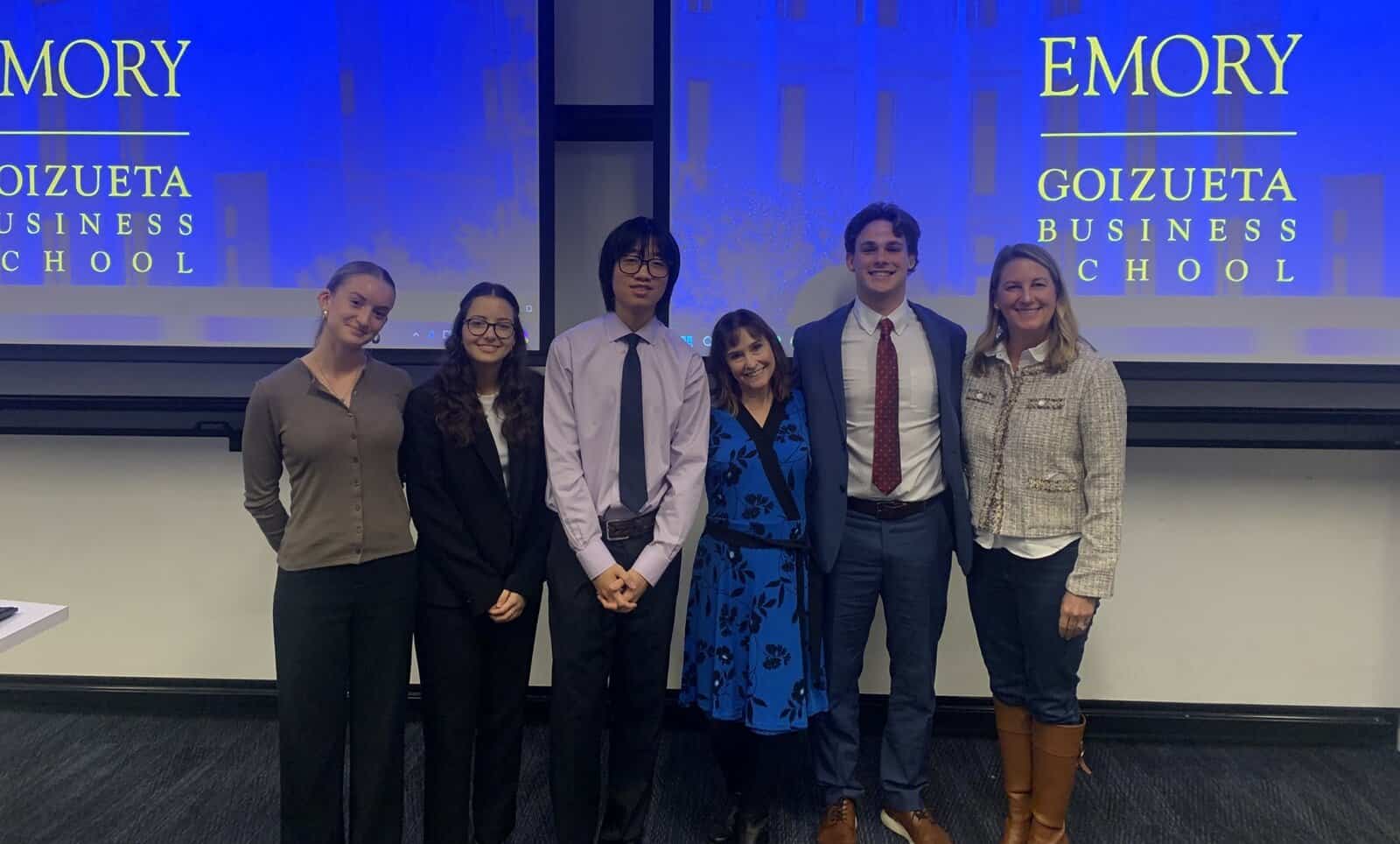
In Goizueta’s Business Communications Strategy course (BUS 365), undergraduate BBA students developed internal communication strategies to help Cox Communications navigate organizational change.
In today’s business landscape, companies must evolve rapidly to remain competitive and resilient. While this evolution can bring positive and necessary changes for organizations, periods of transformation often create uncertainty for employees. As companies adapt their strategies, structures, and ways of working, how they communicate with their workforce becomes critical to reducing anxiety, reinforcing culture, and building trust.
Last semester, as part of Goizueta’s Business Communications Strategy course, Cox Communications, a major U.S. telecommunications provider serving nearly 7 million customers across 18 states, tasked Goizueta students with helping the company do just that.
Designed to equip students in Goizueta’s undergraduate Bachelor of Business Administration (BBA) program with the tools necessary to craft and deliver compelling client presentations, the course culminates in a communication strategy case competition where, over five weeks, student teams work to provide recommendations for a real-world business challenge given to them by an actual client.
A Different Kind of Case
Historically, the client cases have been advertising and marketing driven, but the ask from Cox Communications added a new twist, explains Steve Savage, assistant professor in the practice of organization and management. “When employees are facing uncertainty, how do we build systems and processes that facilitate their full engagement in the workplace?” Savage says. “As faculty members, what drew us to this case was that it’s different to what we’ve done before.”
The students were asked to deliver two solutions. The first was to pick a core communications task performed by the communications team and to recommend an emerging technology or technologies, such as Microsoft Copilot or Axios HQ, to maintain message consistency and efficiency.
The second was to design a proactive internal communications strategy to reinforce Cox’s cultural continuity and trust, reduce attrition and maintain productivity in times of uncertainty. The students were given a (fictitious) budget of $100,000 and a little over a month to complete the project.
Starting With the Right Questions
To create a compelling strategy, the students needed to understand the audience they’d be targeting, the leadership structure of Cox’s communication department, and the role the company’s human resource function played in employee-facing communications.
“During the weeks leading up to the final presentation, the students asked questions that showed they read and understood the brief and really wanted to roll up their sleeves, ask questions, and make sure they fully understood the context before making recommendations,” explains Gretchen Crawford 96C, director of corporate communications at Cox Communications. “Not only was this a great indicator of success with this project but also makes me confident in their success down the road, as people are often too hasty to make a recommendation that can risk missing the mark when they don’t take the time to understand the nuances of the situation.”
Student Solutions in Action
At the end of the semester, four student teams were chosen by their professors—Savage and Nikki Graves, associate professor in the practice of organization and management—to deliver final presentations to the client.
Ravi Monteiro 27BBA described the project as “far from easy.”
“Cox is a large and complex corporation,” says Monteiro. “So developing a solution that was not only innovative but also realistic and applicable required extensive brainstorming, debate, and problem-solving.”
Monteiro was a member of winning team Emma 4—named after the team’s teaching assistant, Emma Flowers 27BBA—along with teammates Noah Mulugeta 27BBA, Isabela Rodrigues 27BBA, Reed Edwards 27BBA, John Wei 27BBA, and Rhea Krishman 27BBA.
During their presentation, team Emma 4 introduced Anxious Andy—a fictional, entry-level employee at Cox. Andy has been receiving company information from Cox’s corporate communications department, mostly in the form of generic emails that he doesn’t always read.
Using AI Video to Improve Internal Communication
To make the delivery of information more compelling, the team chose the AI-powered video creation platform Synthesia as a scalable, affordable, efficient way to communicate with employees.
Synthesia uses AI to automatically generate a video from text—no cameras, no lighting, no chasing down the CEO for an interview. And if the information changes, the communications team can rewrite the text/script and generate an updated video. The platform offers a library of AI avatars that can “deliver” the script as well as AI voiceovers in 160+ languages and accents. Users can also create a personalized avatar—such as the CEO or another member of the leadership team—along with a cloned voice of that person. Video analytics track views, watch time, clicks, and other engagement metrics.
“We followed Cox’s ask really closely and focused on what would actually solve the employee engagement challenge,” explains Rodrigues. “Synthesia stood out as a tool that can make communication faster and more consistent, especially during uncertain times, while still keeping messaging human and easy to understand. It felt like a strong solution because it improves communication efficiency without losing clarity or connection.”
Listening to Employees During Times of Change
Team Emma 4 also suggested complementing Synthesia with Microsoft Viva Glint, Microsoft’s employee listening and engagement tool. The platform helps an organization monitor its organizational health through surveys, use analytics to identify trends, and turn employee feedback into actionable insights. The team also suggested implementing Viva “change champions,” real Cox employees that would “bridge the gap” between data collection and workplace improvement.
Once implemented, the team concluded that the combination of solutions would greatly reduce Anxious Andy’s anxiety. Synthesia videos would replace email clutter and offer clear and consistent communication. Microsoft Viva Glint would give Andy and his co-workers a way to communicate how they were feeling and allow leadership to spot issues early. Cox could then work to improve the employee experience and help employees feel more connected to the company’s mission.
“Breakdowns in internal communication—more than strategy or operations alone—often drive employee anxiety, disengagement, and performance decline,” notes Graves. “The winning team positioned AI not as a replacement for human leadership, but as a complement that can improve clarity, consistency, and trust during periods of organizational change.”
Preparing Students for Real-World Business Challenges
The final presentations exceeded Crawford’s expectations. “They were sharp and well-reasoned. What stood out most was how seamlessly they worked together and how confidently they responded to questions,” she says. “It was clear they understood the challenges related to both the business and human aspects of the case study. All in all, it was a great example of applying classroom learning to real-world application.”
Savage believes the Business Communications Strategy course’s final case competition underscores the benefit of the class. “There are a variety of different answers and no one ‘right’ solution. It’s all about how you justify an answer, how you think about it,” he explains.
“Students struggle with ambiguity, but I think at the end of the semester they come out with a stronger appreciation that business isn’t cookie cutter,” says Savage. “The world isn’t cookie cutter either, and the skills that they’re learning will help them in the long term.”
“Our experience in the Business Communications Strategy course as a whole was incredibly impactful,” adds Monteiro. “Throughout the course, we developed skills well beyond the classroom—from public speaking and professional presence to learning how to present clearly and confidently to real clients with real constraints. Presenting solutions that Cox could genuinely consider implementing made the experience especially meaningful, and having that tangible, real-world impact is what makes this course such an outstanding one that truly prepares students for future endeavors.”
Goizueta’s Bachelor of Business Administration (BBA) program prepares students to work with real clients and tackle real-world business challenges. Learn more about the undergraduate BBA degree.