
Goizueta’s Karl Kuhnert, professor in the practice of organization and management, is exploring how AI-powered digital twins could make expert human judgment available when high-stakes decisions demand it most.
Picture this scene.
You have a patient in the Intensive Care Unit. Their lungs are no longer working, and breathing for them is a full life-support system—extracorporeal membrane oxygenation. The situation is critical, and the only way this patient is going to survive is via a lung transplant. The good news? A donor organ has just been received by your transplant team. However, before this life-saving surgery can begin, you have to make two critical decisions—and the clock is ticking.
First, you need to assess the quality of the organ and its donor, including the age and health of the individual, whether or not they smoked, their blood type, and a whole slew of other compatibility factors to determine whether or not the lungs are suitable for transplant. Second, that patient in the ICU is not the only one waiting for a new lung. Now you need to decide whether this particular individual is the right recipient or whether it could go to someone else on your transplant waiting list. This means working through a new set of variables. Will this person be able to survive such a dangerous procedure? What other medical conditions, infections, or immunological factors are there to consider? What is their outlook should they survive the operation?
In front of you is a life-or-death decision. Making the right call hinges on your expertise, but also on your reasoning. You need to figure out which variables matter most, which carry the most weight, and how they interact with each other. And your window is narrowing by the second. You’ve got less than 60 minutes to decide. Get it wrong, you might seriously harm your patient—or deprive someone else from a life-saving opportunity.

Scenarios like the one above may sound like something straight out of Netflix, but these are the high-stakes decisions that physicians have to make every day, and often under severe time pressure, or sometimes in the middle of the night after an exhausting day of work. Access to data is critical but as any pulmonologist will tell you, information is only part of the story. Making the call with any real certainty also hinges on tacit knowledge: the know-how, the deep expert reasoning and judgment; on an almost-instinctive ability to weigh up the odds and pinpoint the best course of action. It depends on that kind of hard-won, hands-on experience—experience that only accrues after decades of work.
For younger physicians—junior or mid-career doctors—AI tools can help synthesize data, and they can do this fast. What they can’t do is provide that all-important second opinion that only seasoned practitioners can bring to bear; human experts steeped in the experience of synthesizing, reasoning, learning, and building targeted wisdom. So how do you bridge this expertise gap when you can’t physically bring a senior practitioner into the room? How do you tap into that kind of expert judgment—especially in real time, and with the clock ticking down?
Professor in the Practice of Organization & Management Karl Kuhnert has built a body of work examining how experience becomes expertise. He collaborates with diverse industry and research organizations, exploring how leadership and decision-making effectiveness emerges from the meaning we make from the challenges, contradictions, and experiences that shape knowledge and skills across the lifespan.
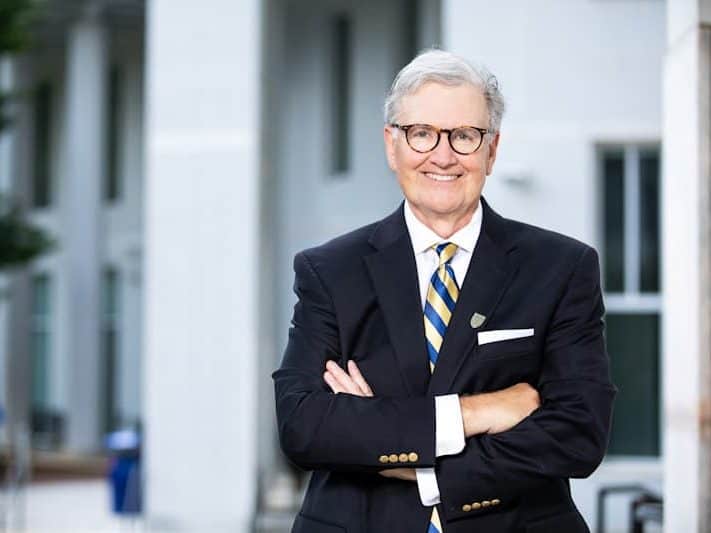
His most recent collaboration is with Merlynn AI, makers of an AI-powered system designed to capture and model expert human judgment called Tacit Object Modeler, or TOM. Together with Merlynn researchers and leading AI consultant Mark Keith, Kuhnert has helped develop a “decision-making digital twin” based on TOM, a digital “facsimile” of real-life human expertise that physicians—and other practitioners operating in high-stakes, time-pressured settings—can consult as a trusted sounding board on demand and in situ.
“In critical situations, the difference between doubt and certainty—life and death even—can be access to the right expertise at the right moment. And you can’t expect to have the human expert on hand or on call every time this happens,” says Kuhnert.
“TOM has the potential to reproduce real-life human reasoning and expertise in the room in real-time and at scale, when the situation or the need is most acute. And that has the potential to transform outcomes for physicians, for their patients, or for any decision-maker looking for a second opinion when the stakes are high.”
How AI Models Expert Judgment
The TOM prototype leverages Merlynn’s modeling technology with Kuhnert’s research. It works by both capturing and then replicating the decision-making expertise of a human practitioner. What makes TOM interesting, says Kuhnert, is that it does this by observing and modeling “tacit knowledge”—the often subconscious rules, intuition, and judgment that a highly experienced person deploys but may struggle to articulate.
TOM is primed to create a simulation of a decision environment and then analyze the decisions made by a human expert over a sequence of different scenarios, observing and then working out the underlying heuristics or judgment rules that the expert is using. These rules are then used to build a digital twin of the expert—an AI model that can dynamically make decisions the same way the human being would.
“TOM doesn’t just capture and reproduce what the human expert knows,” says Kuhnert. “It precisely models the way that our expert thinks, weighs variables, and arrives at their judgment when they confront a complex decision.”
The prototype has been developed with help from Merlynn, as well as Keith and Kuhnert in collaboration with Dr. Purav Shah, a leading pulmonary specialist with Emory Healthcare.
“We had TOM present hundreds of systematically varied scenarios to Dr. Shah and observe his decisions over and over to infer the underlying structure of his expert judgment,” says Kuhnert. “Across the scenarios, TOM is able to capture how it is, after years of experience, that Dr. Shah can pinpoint patterns, weigh competing signals and considerations, decide which variables matter most, and ultimately make the decision—which organ, which patient.”
Pictured below is the TOM portal in action, as well as a real-world scenario the tool helped to negotiate with Dr. Shah:
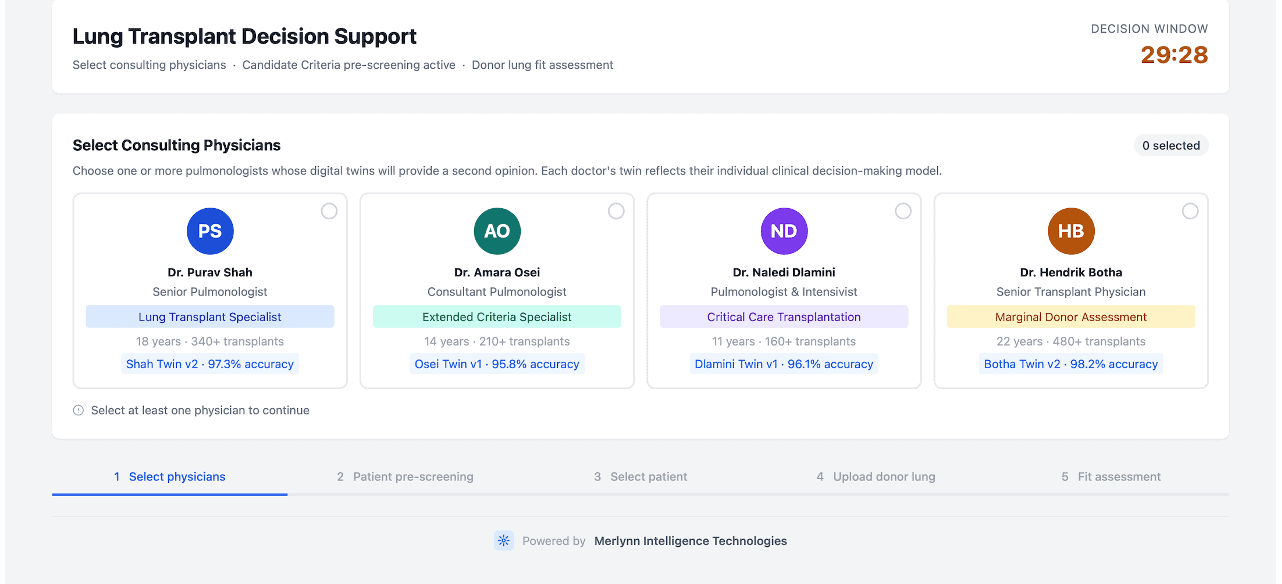
| “A 38-year-old female patient diagnosed with lung fibrosis due to lupus is currently on the lung transplant waitlist. She is on 1L of oxygen at home due to her lung disease. She is blood group O and does not have antibodies that could preclude her from transplant surgery. She has a decent waitlist score. She receives an offer from a 78-year-old donor who was a 40-pack-year smoker. “The donor also has right lung pneumonia on the CT scan of the chest. The blood gases are also marginal, with a P/F ratio of 280. This is a measure of how well the lungs transfer oxygen into the blood stream, ranging theoretically from 0 – 660, with lower values considered worse. I would not accept this donor for my patient because the offer is marginal and my patient can wait for a better offer. “The donor’s advanced age, smoking history, low P/F ratio, and CT scan findings are prohibitive, as they are collectively associated with poor outcomes in the recipient post-transplant. On the other hand, my patient is not very sick, nor is she sensitized or hospitalized. As a result, she has time to wait for a better organ offer.” Dr. Purav Shah. |
Testing the Model
To gauge the accuracy of the model, Kuhnert and his colleagues have TOM create a number of additional scenarios and run the decision-making processes. These scenarios are then presented to the human expert—Dr. Shah—and his decisions are compared with TOM’s. To date, decision consistency has been close to 100 percent, says Kuhnert.
“We are seeing the model and the human expert reaching the same decision across all the scenarios tested. And the possibilities are stunning. We have run scores of scenarios with Dr. Shah. TOM consistently maps and models Dr. Shah’s expert reasoning to create his ‘digital twin’—a real-time, instantly accessible and reliable copy of Dr. Shah that can be presented to any other clinician—a more junior colleague, say, facing a tough decision about a transplant.”
TOM brings Shah—and, potentially, any other human expert—into the room to assess, ponder, and weigh in on a complex situation, precisely when a second opinion matters most, says Kuhnert. But there’s a caveat: the digital twins created with TOM are not designed to stand in for the attending physician’s personal judgment, nor should TOM assume full responsibility for a clinical decision.

“TOM’s digital twin is designed to be a second opinion, a sounding board that says, ‘In this situation, Dr. Shah would probably accept this lung, and the variables he tends to weigh most heavily are X, Y and Z.’ Now, the treating physician might agree, disagree, or investigate any of those variables further, but the ultimate responsibility for the decision will rest with them, not with the digital twin.”
Users still need to exercise their own judgment, says Kuhnert. The idea is not to simply furnish junior practitioners with “an answer,” but to provide access to the judgment and reasoning that form and inform expert decision-making, and invite examination, analysis, and challenge. “The value is not in treating expert judgment as infallible, but in making it attributable, transparent, and revisable. If five leading cardiologists reach different conclusions, the insight isn’t simply in comparing their answers, but in understanding the reasoning each brings to the case.”
Scaling Expertise
Healthcare applications of decision-making digital twins are still in the early stages of development and testing, and Kuhnert and his colleagues are actively researching potential use cases for providers. But the potential is extraordinary, he says.
“Healthcare offers perhaps the clearest and most consequential test case, but the digital twin concept applies to just about every profession that relies on judgment: executives learning to navigate uncertainty and strategic trade-offs; attorneys learning to recognize risks embedded in precedent and context; engineers learning to anticipate unintended consequences—across any field where expertise develops through experience, apprenticeship, reflection, and exposure to increasingly complex situations. The potential is to make that developmental process more accessible, scalable, and effective but without undermining or subverting individual agency.”
The next frontier for AI may not be scaling information, says Kuhnert, but scaling expert judgment: apprenticeship at scale, with AI as a developmental partner that helps people become better decision-makers.
“It’s about helping less-experienced professionals and students think more deeply about the challenge, context, uncertainty, and consequences of a decision. The best experts combine know-what with know-how. If expert human judgment becomes available on demand, we’re accelerating how professionals learn, grow, and develop their judgment throughout their careers without the limitations of geography, access, or privilege.”
Explore more ideas shaping the future of business. Discover the latest research and insights from Goizueta Business School faculty, exploring emerging technologies, leadership, and the challenges facing organizations today. Explore Goizueta faculty research.