

New research suggests mindset alone isn’t enough—certainty may be a missing ingredient
In classrooms, boardrooms, and self-help books, the idea of a “growth mindset” has acquired an almost spiritual luster: believe you can improve, and you will. The concept has shaped educational policy and leadership philosophy for over a decade. But as with many academic maxims that are distilled and distributed mainstream, the story has started to fray. Some recent studies suggest the effects of growth mindset interventions are smaller or less reliable than once thought. Is the theory flawed—or is it simply lacking nuance?
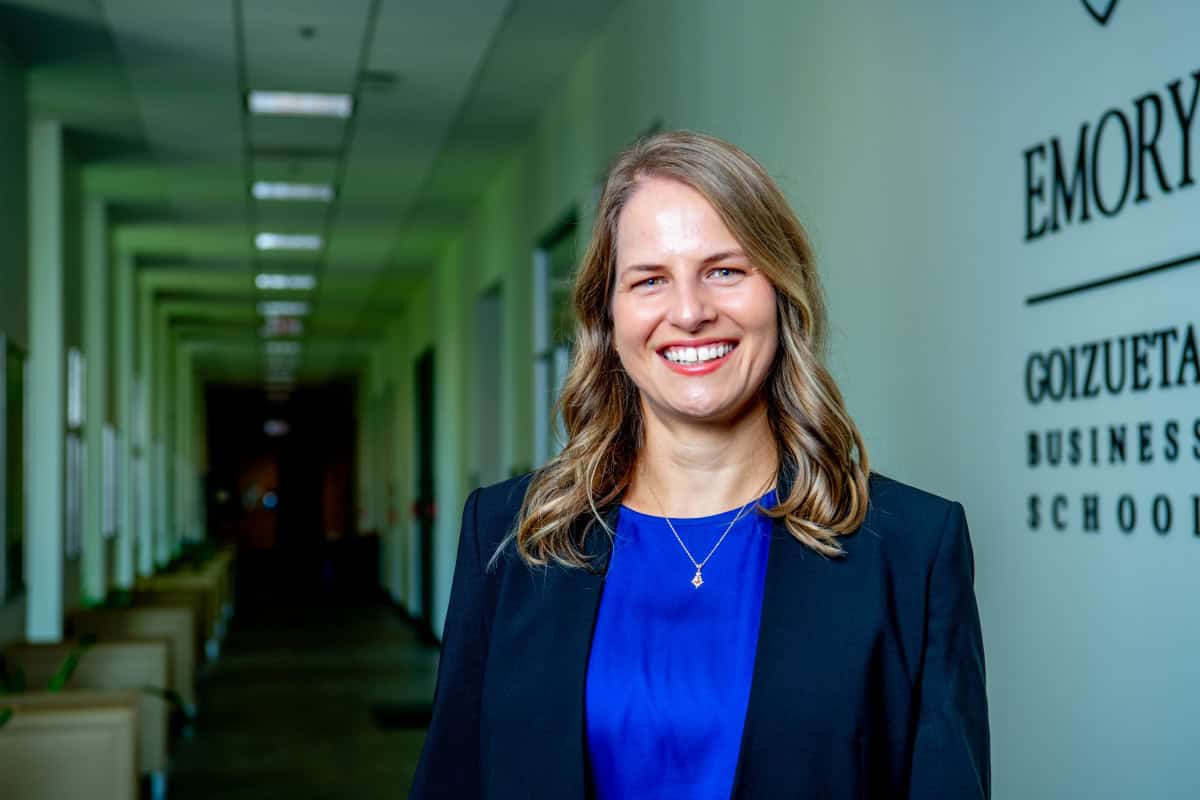
Assistant Professor of Organization & Management Laura Wallace is here to offer some clarity.
Laura Wallace’s research investigates how to change minds, build trust, and address societal disadvantage. Her recent research paper—published with colleagues Kentaro Fujita and Ariana Hernandez-Colmenares of The Ohio State University and Mary Murphy of Indiana University at Bloomington—revisits the debate about the impact of growth mindsets with a new lens, focusing not just on what people believe, but how certain they are in those beliefs. Drawing on insights from decades of attitude research, her work suggests that certainty may be a key factor in determining whether mindsets actually translate into behavior. Her recent studies examine this in the context of how people’s beliefs about intelligence and ability shape the environments they choose to work in.
In other words, it’s not enough to think you can improve; you have to believe it strongly enough to act on it.
“Rather than asking whether growth mindsets matter,” Wallace explains, “we should be asking when they do—under what conditions do people actually act on them?”
Her findings complicate a narrative that has often focused on a binary: are growth mindsets beneficial or not? They also raise practical questions for educators and leaders: if belief alone isn’t sufficient, what does it take to build environments where people actually pursue growth?
Wallace weighs in.
Can you give us a layman’s definition of a “growth” versus a “fixed” mindset? What is the conventional narrative about these mindsets?
Growth and fixed mindsets refer to whether people believe their skills and abilities, like intelligence, can change. People with a growth mindset believe they can develop their abilities through effort and the right strategies. People with a fixed mindset believe they’re born with a certain level of ability and can’t do much to change it.
A large body of research has found that growth mindsets are generally beneficial. People with growth mindsets tend to persist through challenges, seek out opportunities to improve, and respond constructively to critical feedback. People with more fixed mindsets tend to give up when things get hard, focus more on looking smart than getting better, and become defensive when criticized. Growth mindsets have also been shown to help reduce racial and gender achievement gaps.
As a result, many schools have launched growth mindset programs, and companies like Microsoft have built entire cultures around the concept.
What question were you trying to answer that the existing literature had not resolved? What first made you suspicious that the field was asking the wrong question about mindset effects?
Recent work has raised questions about whether growth mindset findings reliably hold up. Some researchers have found the effects are small or inconsistent. Most of this debate has centered on a binary question: do growth mindsets work or not? I wouldn’t go so far as to say that’s the “wrong” question, but I do think it’s a limited one.
I wouldn’t go so far as to say that’s the “wrong” question, but I do think it’s a limited one.
Rather than asking whether growth mindsets matter, we ask when they do.
Laura Wallace, Assistant Professor of Organization & Management
It seems like a shame to just toss growth mindsets out the window when decades of research suggest they can be such powerful tools. Instead, it seemed likely to me that there were situations under which growth mindsets were particularly likely to have their positive effects. If we could identify those, then we could still take advantage of growth mindsets and be informed about when and how to best do so.
My thinking was shaped by my background studying attitudes: people’s opinions and beliefs. In the 1960s and 70s, attitude researchers faced a similar crisis: studies showed that people’s opinions didn’t reliably predict their behavior. Some researchers called for giving up on the study of attitudes entirely. But others asked a more useful question: when do attitudes predict behavior? One key answer was certainty — people act on beliefs they feel confident in.
I thought the same logic might apply to mindsets. And as it turns out, it does.
Were there any findings that surprised you—or complicated the tidy version of the “growth mindset” story people may already know?
Given my background, the core findings weren’t a surprise. But I think our work adds an important nuance: it’s not enough to give people a growth mindset; if you want them to act on it, you also need to help them feel certain in it.
That has important implications for how organizations and educators approach growth mindset interventions. Simply telling people “you can improve” may not be enough. Showing them that others share that belief—for instance, that their peers or colleagues also endorse a growth mindset—can increase certainty, because people tend to feel more confident in beliefs that are socially validated.
I think the other thing that may not be intuitive is that certainty is not the same thing as extremity. That is, people may often think that the more someone endorses a growth mindset (the more extreme growth mindset view) they have, the more certain they will be. However, people across the mindset scale vary in how certain they are. Further, the extremity of a mindset on its own is not sufficient to predict which mindsets will be impactful and which ones will not.
You set up experiments in which professors (and other professionals) cued as either mindset camp of “fixed” or “growth.” What kinds of cues indicate that someone believes in one mindset or another? What language might they use?
Sometimes people directly state their beliefs. I do this with my students, where I directly tell them that I believe each of them is capable of improving their skills and abilities with effort and the right strategies. In our studies, we also use company or non-profit mission statements that include things like valuing development (growth mindset) or having the smartest people (fixed mindset).
Indeed, people and companies that have more growth mindsets tend to give others more opportunities to learn and grow, whereas places with a fixed mindset focus on having their employees demonstrate their performance.
Microsoft, for example, states on its website that growth “isn’t just possible—it’s expected,” and describes potential as something to be nurtured rather than predetermined. By contrast, former Enron CEO Jeff Skilling described their hiring philosophy as seeking people who were “incredibly bright”—language that signals a fixed mindset, focused on identifying innate talent rather than developing it.
What should leaders take from this if they want to build a culture that helps people learn and perform? Did this research change the way you think about your own teaching, mentoring, or leadership?
Our research suggests that if you want people’s growth mindsets to predict their choices, you also need to make them certain in them. Although we don’t directly test this, one approach that is likely effective is to build a culture of growth, as people tend to be certain in beliefs that they think others also endorse.
There’s also good evidence that growth organizations tend to be more innovative, collaborative, and ethical. The evidence on whether employees perform better in them is still mixed, but they do tend to be better places to work.
This work has made me take more seriously the idea of not just communicating my growth beliefs but giving the evidence behind them to boost certainty. When students struggle on my first exam, I don’t just tell them I believe they can improve. I show them data from past classes demonstrating that many students who struggled early ended up doing well by the end of the course. I share quotes from previous students who adjusted their study strategies and turned things around. I’ve taken seriously the idea that I can’t just tell students to believe in themselves; I need to actually make them certain that improvement is possible.
Where do you see the implications extending beyond classrooms—to hiring, team culture, performance reviews, or employee development?
Our work suggests that people are most interested in joining organizations that match their own mindset—but only when they hold their own mindsets with certainty. This suggests that from a hiring standpoint, people are likely self-selecting into organizations that are a good fit for them, but it also means that organizations are likely getting siloed as either fixed or growth.
One finding I find particularly worth noting: people with uncertain growth mindsets are more likely to end up joining fixed organizations.
I suspect this puts them at risk: uncertainty makes people more susceptible to belief change, so they may gradually adopt a fixed mindset. Over time, that could make them less resilient when they face challenges.
What is the next research question this paper opened up for you?
We’re pursuing two follow-up questions.
The first is about mindset change. This paper looked at how certainty shapes whether a mindset predicts behavior, but certainty also affects how open people are to changing their beliefs in the first place. Persuasion research shows that people who hold a belief with high certainty are much harder to persuade than those who are uncertain. In the context of mindsets, that’s practically important: if someone is deeply certain in a fixed mindset, it’s going to take a lot more than a single intervention to shift them. Understanding that upfront could help organizations and educators develop more targeted strategies, moving quickly with people who are uncertain and taking a more gradual approach with those who are firmly entrenched.
The second is about task choice. We know that people with growth mindsets tend to seek out challenges, but we’re interested in what, beyond certainty, predicts whether someone actually chooses a harder, growth-oriented task over an easier one that just lets them look good. One candidate we’re exploring is values: when people see their mindset as a reflection of who they are and what they stand for, they may be more likely to act on it. If that’s right, it suggests another lever for helping people translate a growth mindset into growth behavior.