
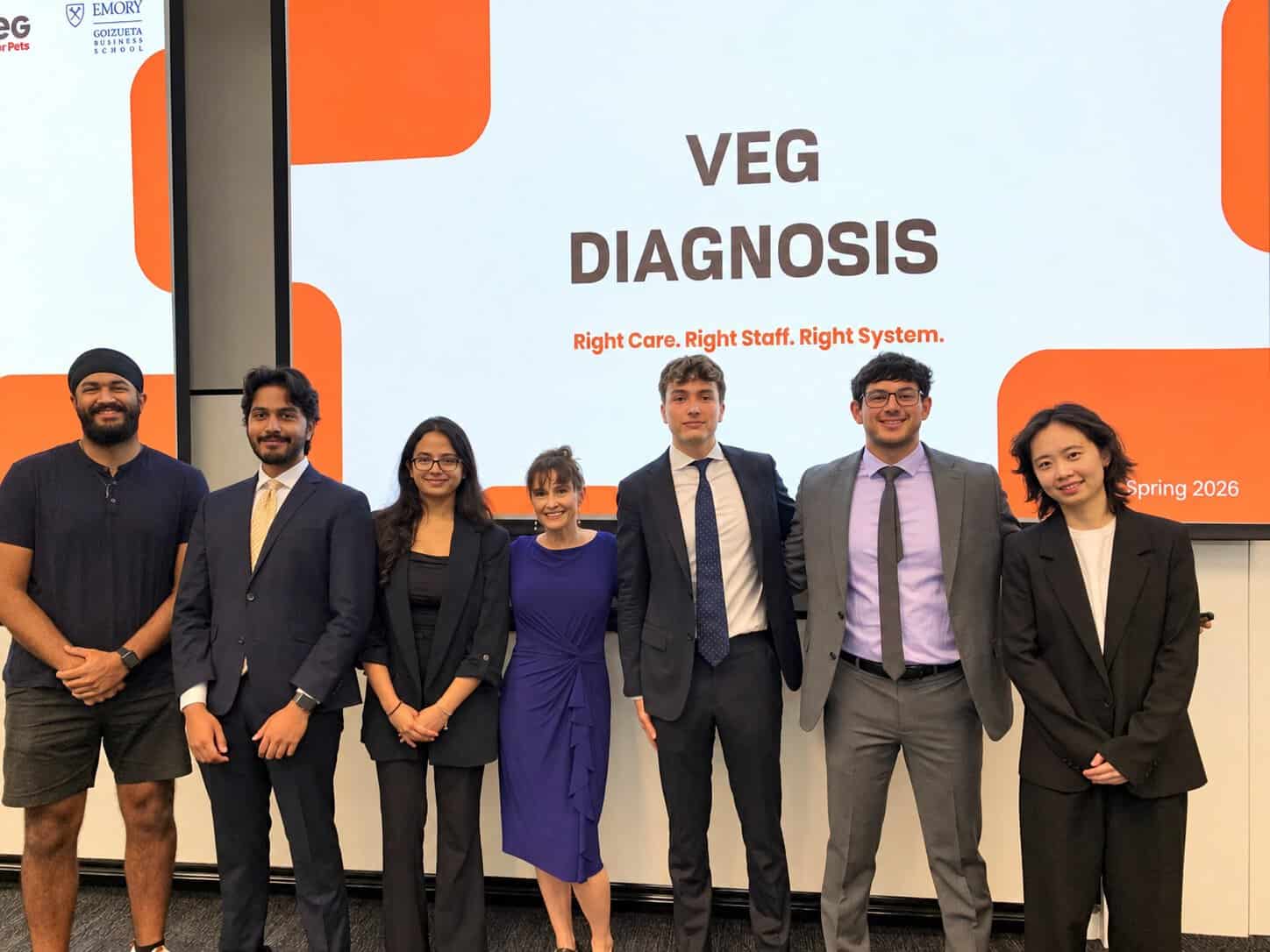
Students in Goizueta Business School’s undergraduate Bachelor fo Business Administration (BBA) program partnered with Veterinary Emergency Group (VEG) to solve real-world staffing and growth challenges for a rapidly expanding business.
Veterinary Emergency Group (VEG) ER for Pets has become one of the nation’s fastest-growing specialty veterinary companies since its founding in 2014. Built around a customer-centered approach to emergency veterinary care, the company nearly doubled its footprint in just two years to 135 hospitals across the United States and Canada, employs more than 7,000 people, and plans to open more than 30 hospitals annually.
That rapid growth has created new operational challenges, particularly around staffing. Because the company prides itself on putting its employees—affectionately known as “VEGgies”—first, as the company expands, labor decisions must balance employee well-being with financial performance and high-quality patient care.
This spring, Veterinary Emergency Group turned to students in Goizueta Business School’s Business Communication Strategy course to help tackle that challenge: How should the company evolve its labor and compensation models to support its veterinary professionals while sustaining long-term growth?
This project challenged students not only to analyze data, but also to turn their findings into compelling insights and communicate them effectively to the client.
Steve Savage 21EvMBA, Assistant Professor in the Practice of Organization & Management
Answering that question meant the students had to think like operators: Should staffing be based on patient count, complexity, revenue, or some combination? And if hospitals began treating more complex cases, should the staffing model adjust weekly or evolve gradually over time?
“One of my favorite aspects of our course is that the final projects always look different, reflecting the true breadth of what business is, and the Veterinary Emergency Group case is no exception,” said Steve Savage 21EvMBA, assistant professor in the practice of organization and management. “This project challenged students not only to analyze data, but also to turn their findings into compelling insights and communicate them effectively to the client. This project stretched our students, and I couldn’t be prouder of the work they put in.”
Scaling a People-First Culture
After graduating from Goizueta’s undergraduate Bachelor of Business Administration (BBA) program and earning his MBA from Wharton, Veterinary Emergency Group’s president & co-founder David Glattstein 04BBA built a career in private equity and investment management before teaming up with his co-founder David Bessler DVM, to reimagine the veterinary emergency business model.
Operating around the clock, Veterinary Emergency Group’s hospitals rely on highly trained veterinarians, nurses, and support staff willing to work nights, weekends, and holidays. As the company has grown, determining how many employees each hospital needs—and how those employees should be rewarded—has become increasingly complex.
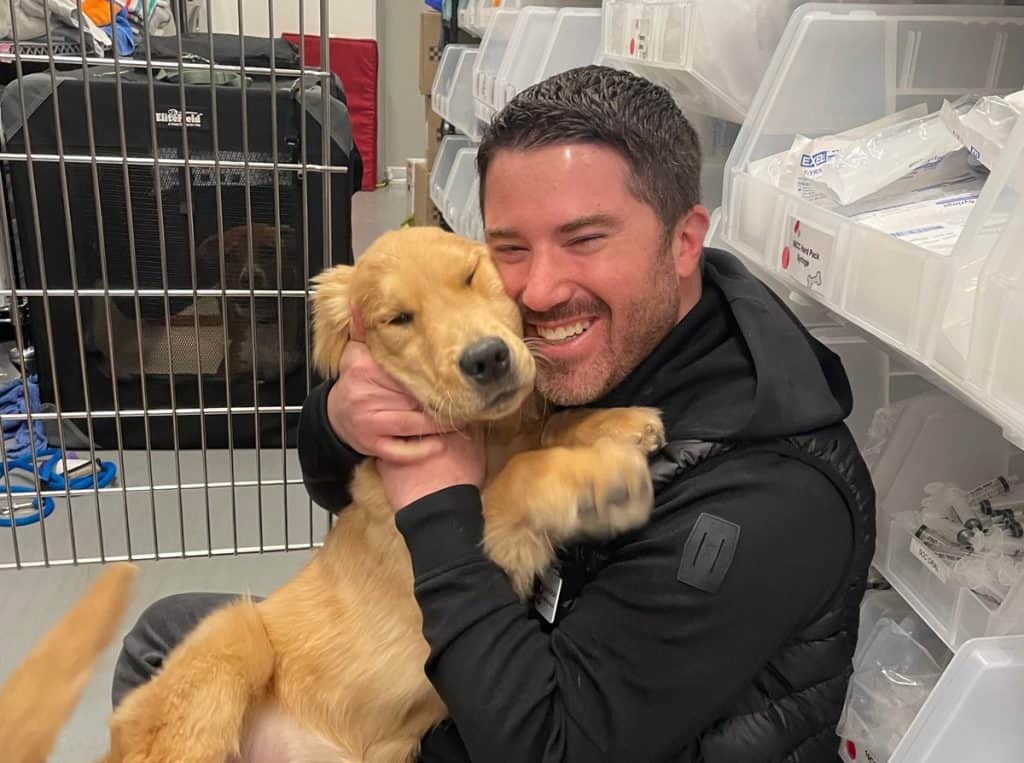
Beyond staffing, the company also challenged students to rethink compensation. Should skill advancement automatically result in permanent raises? Could bonuses or career development opportunities better reward growth while remaining financially sustainable?
“Students should consider how their recommendations across both problems work together as one coherent strategy,” notes the project deliverables outline. “This case situates you at the intersection of healthcare (veterinary medicine) operations, workforce economics, incentive design, growth strategy, organizational culture, and data analytics.”
Solving for Growth
At the end of the semester, six teams were chosen to present their ideas to Veterinary Emergency Group leadership.
“We were honestly a bit nervous that the case might be too ambitious, as it required balancing financial, operational, and people-related considerations simultaneously,” says Sarah Pruitt, Veterinary Emergency Group’s senior vice president of central operations. “The finalists rose to the challenge and delivered thoughtful, well-researched recommendations. I was particularly impressed by how many teams incorporated AI-driven solutions and supported their ideas with external research and industry studies.”
The runner-up team in the competition, Valuing Our VEGgies, proposed a targeted acuity-based staffing overlay for hospitals experiencing the greatest strain from complex inpatient cases, and redesigned nurse compensation by incorporating inflation-adjusted raises, achievement bonuses, and a structured mentorship program.
“Their polished presentation and practical implementation plan demonstrated a strong understanding of how organizations can support employee growth while maintaining operational and financial sustainability,” notes Nikki Graves, associate professor in the practice of organization and management.
The finalists rose to the challenge and delivered thoughtful, well-researched recommendations.
Sarah Pruitt, Senior Vice President of Central Operations, Veterinary Emergency Group
The winning team, The Consulting Caregivers, included Jade Feng 28BBA, Sam Pittman 28BBA, Maxime Promeyrat 28BBA, Rhea Agarwal 28BBA, Samuel Gouvalaris 28BBA, and Himanish Lingamaneni 28BBA.
Their proposal recommended an acuity-based staffing model that aligns labor resources with patient complexity and a redesigned compensation system that rewards skill development while improving long-term financial sustainability.
“Their recommendation connected staffing, compensation, and employee development into a single strategy designed to improve patient care, reduce burnout, and support Veterinary Emergency Group’s continued growth,” explains Graves.
Creating a practical recommendation required the team to understand more than the data, said Consulting Caregivers team member Rhea Agarwal 28BBA. The team had to understand the people for whom they were designing the solution.
Several of the ideas presented are concepts we plan to explore further within our organization.
Sarah Pruitt, Veterinary Emergency Group
To validate its assumptions, the team followed up with targeted questions for Veterinary Emergency Group and conducted additional research. “We were solving a problem that would help an established company. That made not only the stakes, but also our motivation, much greater,” says Agarwal. “It also allowed us to get better clarity on the assumptions we were making, something which wouldn’t have been possible in a hypothetical case study.”
Sam Pittman 28BBA credited the team’s clear division of responsibilities for helping it deliver a winning proposal. “[It] kept us each accountable for our portion of the project, and our collective enthusiasm kept everyone optimistic about the deliverable,” he says.
Ideas with Real Impact
“The presentations were creative, practical, and demonstrated a strong understanding of the real-world challenges Veterinary Emergency Group and other organizations face,” Pruitt says. “In fact, several of the ideas presented are concepts we plan to explore further within our organization.”
“David Glattstein saw an opportunity to connect two worlds he cares deeply about: developing future business leaders and solving meaningful business challenges,” Pruitt continues.
“The students embraced a complex, real-world problem and brought fresh ideas, research, and innovation to the table. It was a win for everyone involved.”
Through hands-on experiences with leading organizations, Goizueta’s undergraduate BBA program prepares students to solve complex business challenges from day one. Learn more about the Bachelor of Business Administration program.